Thursday, 11 September 2025

Poems written during WW1 in an autograph album

Historian Debbie Cameron posted this on her Facebook Page Remembering British women In WW1 -The Home Front & Overseas 

https://www.facebook.com/groups/1468972083412699/posts/3668126483497237/?comment_id=3668806230095929&reply_comment_id=3668812406761978&notif_id=1757589093891533&notif_t=group_comment_mention

"I recently posted on my weblog about an autograph book I have that belonged to Doris Freeman (Dolly) a Member of the WRAF, stationed at Lympne in Kent in World War One.  


While reading some of the poems before further research, I realised that as well as the usual "ditties" and quotes, there were several poems that were written by friends of Dolly that relate to their experiences in the War as it was happening.   I thought it would be fitting to publish these - in their own way as important and authentic as the so-called "War Poets". 

Don’t worry about trying to decipher them…My post gives a transcript of the poems!   I particularly like a rather jaunty one in which the writer looks ahead to a Christmas at peace and with the daughters’ service recognised, as well as ma’s!”

Debbie's weblog is   http://historicalclues.blogspot.com/2025


Saturday, 19 July 2025

Agatha Christie (1890 - 1976) – British writer, poet and WW1 VAD

With thanks to Debbie Cameron* for this amazing discovery and for her permission to share it with you.

Debbie explains her discovery:

“This is brilliant. I found it on a Royal College of Nursing website:

  “What we did in the Great War’, a hand-made magazine created by Agatha Christie and other VADs, 1918. Before she became the world’s leading crime novelist, Agatha Christie served as a volunteer nurse (VAD) in the First World War. 


She created a remarkable magazine with fellow VADs. It includes a fascinating array of illustrated articles, dramatic scripts and musical scores. There is even a comic strip story featuring a poisoning – a theme that Christie would return to in her best-selling crime novels. Lent by The British Psychoanalytical Society Archive

Lucy London there is a poem by the great lady herself. About pharmacists! 

I think these are the only pages digitised: “

https://www.rcn.org.uk/servicescrapbooks/


NOTES: 

Agatha was born Agatha Mary Clarissa Miller on 15th September 1890 in Torquay, Devonshire, UK. Her parents were Frederick Alvah Miller, an American “gentleman of substance", and his wife Clarissa "Clara" Margaret,  née Boehmer. She was the youngest of three children 

When Agatha grew up, she had short-lived relationships with four men and an engagement to another. In October 1912, she was introduced to Archibald "Archie" Christie at a dance given by Lord and Lady Clifford at Ugbrooke, about 12 miles (19 km) from Torquay. The son of a barrister in the Indian Civil Service, Archie was a Royal Artillery officer who was seconded to the Royal Flying Corps in April 1913. The couple quickly fell in love. Three months after their first meeting, Archie proposed marriage, and Agatha accepted.

During the First World War, Agatha Christie served as a nurse in a Voluntary Aid Detachment (VAD) at a makeshift hospital in Torquay Town Hall. She worked with the Red Cross caring for wounded soldiers, assisting in the operating theater, and later worked in the dispensary. Her experiences during the war, particularly her knowledge of poisons gained while working in the dispensary, significantly influenced her later writing, especially her use of poison as a murder weapon in her detective novels. Her first novel - "The Mysterious Affair at Styles" - was written during that period and published after the war.

Original source:

*Historian and writer Debbie Cameron has this Facebook Page dedicated to the women of WW1 *https://www.facebook.com/groups/1468972083412699/?multi_permalinks=3582402482069638&notif_id=1749058185896028&notif_t=feedback_reaction_generic_tagged&ref=notif

Additional sources:  Find my Past and Wikipedia


Thursday, 26 September 2024

Good news from Bairbre O’Hogan regarding her biography of Winifred Mabel Letts

I am delighted to let you know that “Sing in the Quiet Places of my Heart”, my biography of W.M. Letts (1882-1972) - poet, war poet, dramatist, children's writer, novelist - will be launched on Sunday 20th October 2024, at 2pm in the recently-refurbished Old Courthouse, Rathcoole, D24 YP97 - as part of the Red Line Book Festival. The book was commissioned by, and is published by, South Dublin Libraries

South Dublin Libraries request that, if interested in attending, you book your place at the launch via The Red Line Book Festival website: W.M. Letts Book Launch | Sunday October 20th 2pm | Red Line Book Festival (redlinefestival.ie)

Following the launch on 20th October, the book will be available for purchase (€20) from South Dublin Librariestallaghtlibrary@sdublincoco.ie

Bairbre O'Hogan, 26th September 2024


Thursday, 5 September 2024

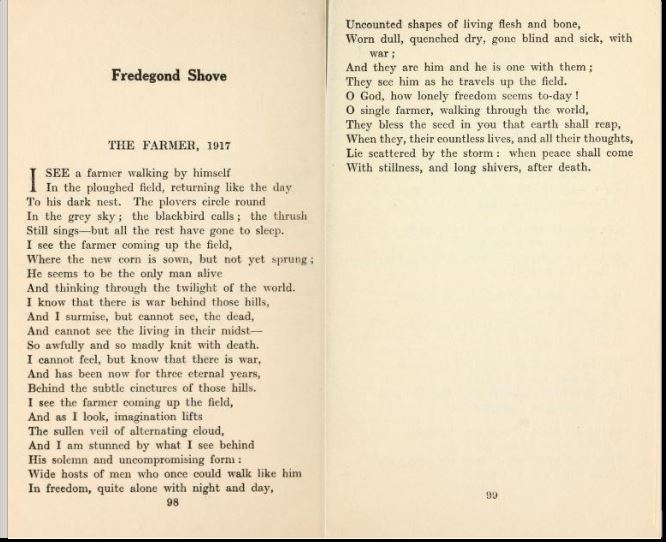
Fredegond Cecily Shove - née Maitland (1889–1949) - British poet.

With thanks to Dr Connie Ruzich* for reminding  me that I had not yet posted my research about Fredegond Shove here 

Fredegond Cecily Maitland was born in Cambridge, UK in 1889, the birth being registered in March of that year.  Her parents were Legal Historian, Frederic William Maitland and his wife, Florence Henrietta, nee Fisher. Friedegon’s father taught English Law at Downing College, St Benedict, Cambridge University.  Her mother was a maternal first cousin of Virginia Woolf and sister of Adeline Maria Fisher, the wife of Ralph Vaughan Williams. Her mother's second marriage to Francis Darwin in 1913 brought her in contact with his extended family. 

Friedegond attended Newnham College, Cambridge University from 1910–1913 and during that period also spent time in London with the Vaughan Williams family.  

Gerald and Fredegond
In 1915 Fredegond married British economist Gerald Frank Shove, who like her own family, had links with the Bloomsbury Group. As a conscientious objector doing farming as his alternative service during the First World War, Gerald worked at Garsington Manor near Oxford for most of 1916–1917. 

The future Juliette Huxley, who was working there as a French tutor, later reminisced: "In those days... I saw a good deal of Fredegond Shove, Gerald's wife, who lived like a Spartan at the Bailiff's Cottage." 

Their employer, Lady Ottoline Morrell, also remembered Fredegond then as "an enchanting creature, very sensitive, delicate and highly strung, with a fantastic imagination".


After her death in 1949, Fredegond was buried with her husband and other family members in the Ascension Parish Burial Ground in Cambridge. Her sister Ermengarde Maitland (1887–1968) acted as her literary executor and had the poet's brief memoirs of her early years and married life privately published as Fredegond and Gerald Shove (1952). In the introduction to this, she described sorting through the house and finding poems "everywhere: fairly copied in note-books, scribbled on bits of paper, stuffed into bookcases, cupboards and desks – one would not have been surprised to have found them in the oven – literally hundreds of poems."

According to Catherine W. Reilly in her Bibliography ”English Poetry of the First World War” (St. Martin’s Press, New York, 1978) - p. 293, Friedegond Shove’s WW1 poems were published under the title “Dreams and Journeys” (Blackwell, Oxford, 1918) and she also had poems published in two WW1 anthologies. (pp. 19 and 23): 


Fredegond's poem from “The paths of glory: a collection of poems written during the War, 1914-1918” Ed. Bertram Lloyd (Allen & Unwin, 1919), pp. 98 - 99.

and in "Men who march away" Ed. L.M. Parsons (Chatto & Windus, 1965).

Sources:  Wikipedia, Find my Past, FreeBMD 

https://www.npg.org.uk/collections/search/person/mp72056/gerald-frank-shove

https://archive.org/details/pathsofglorycoll00lloy/page/n9/mode/2up

* You can also Fredegond’s poem “The Farmer” here  on Dr. Connie Ruzich’s wonderful website Behind their Lines  https://behindtheirlines.blogspot.com/2017/04/conscientious-objectors.html


Saturday, 18 May 2024

M. Waller Paton ( - ) – Poet

 I found this poem written by M. Waller Paton in the First World War Poetry Anthology “One Hundred of the Best Poems on the European War by Women Poets of the Empire”, Edited by Charles R. Forshaw (Elliot Stock, London, 1916), on page 117.  BUT I cannot find anything out about M. Waller Paton.  Can anyone help please?


M. Waller Patton is mentioned briefly in Catherine W. Reilly's “English Poetry of the First World War: A Bibliography” (St. Martin’s Press, New York, 1978) on page  249.

Saturday, 27 April 2024

Ophelia George Mather (1883 - 1972) – British schoolteacher and poet

Ophelia George Mather was born on 1st September 1883  in Derby, Derbyshire, UK.  Her parents were George Henry Mather, a draper and tailor, and his wife, Amelia Sarah Mather, nee George.  

Ophelia trained to become a schoolteacher and lived in Derby all her life.  She frequently had poems published in local newspapers and the following  poem was also included in “One hundred of the Best Poems on the European War By Women Poets of the Empire” Edited by Charles Frederick Forshaw (Elliot Stock, London, 1916) pages 103 – 107.

“THE GLORY OF WAR” by Ophelia George Mather. Also published in “The Derby Daily Telegraph” on 8th October 1915 

THERE'S glory in the khaki stream That passes through the station-gate! Perhaps there's glory in the gleam

That fills the eyes of those who wait ! Its glamour leads them to their homes, And blinds the bright eye w-hen it roams

Around the empty room ! Yet when away with day it steals, What suffering form is this, that kneels Half-fainting with the pain she feels At Glory's stroke of doom ?

Does Glory fill the heart of her

Who hears one voice in ev'ry sound,

And sees but one face everywhere^ And gazes hopelessly around,

Biting the lip to keep back tears

That bode to drown all future years In seas of misery?

Who tries to give, wath scarce a groan,

The only heart that matched her own,

Knowing that she is left alone With Glory's legacy?


Britain, with other lands, will boast How native warriors rushed to meet

The bold invaders of our coast

Until their downfall was complete !

How Glory stood where ranks were thin,

And cheered above the shrapnel-din, And smiled among the stench

Of reeking bodies, graveless still,

By silent wood and lonely hill,

Or sang its most triumphant trill,

In the death-haunted trench !

They'll tell how Glory stood its ground,

Where men half -gasped their lives away, And in the foulest vapours found

The incense of a hero's day ! How Glory let them slake their thirst Where evil brain had done its worst,

And left a poisoned stream ! Still onward Glory's beckoning light Leads through the inky vault of night. Where the air bristles with affright And apprehensive dreams !

Has Glory other charms than these ?

Its radiance penetrates beneath The darkened fathoms of the seas

And there reveals the victor's wreath! Where craftily destroyers creep Among the dwellers of the deep,

In quest of human prey ! Sea-vampires, blood-suckers, or ghouls, With tentacles that bait for souls, Bidding the ocean as it rolls

Hide half their guilt away !


There is no infamy so great But Glory gilds the very deed,

Till our dulled senses estimate The values of a noxious weed,

As though 'twere Honour's stainless flow'r.

The amaranth of lawful pow'r

By Justice proudly worn !

Glory so flauntingly behaves

On land, in air, or on the waves,

That Britain's war-lords in their graves Must turn and writhe with scorn !


There's something more than Glory's dream That makes men choose a sordid death,

Victims of every evil scheme,

Dishonour tainting every breath !

Each building his own funeral pyre

In w'reathing flames of liquid fire Kindled by fiendish hands !

They feel no glory, where they lie

Half-sodden in some loathsome stye.

Some dug-out trap wherein to die, In weary, waiting bands !


There's something, — call it what you will, Revenge, — or outraged sense of right.

Or Nature's own instinct to kill Repulsive germ or parasite !

An impulse to bring down each threat

That dares to menace Britons yet. With arrogant conceit !

Each holds a brief for some dear life.

Defenceless mother, child, or wife.

And enters the ignoble strife. Us purpose to defeat !


With such a bold yet skulking foe There is no glory in the fight !

Truce-violaters cannot know

The line that severs Wrong from Right !

When lying murderers take the fieldj

Is there one Briton who would yield, Or would refuse to go ?

Although he sickens at the thought

Of battles that are foully fought,

Of honour that is set at nought, With mockery laid low !


No ! Not for Glory, nor for Fame !

As once 'twas said in Marlborough's day, But to avenge our own good name,

To stand by comrades, come what may! To stifle bullies in their shame. To make them taste their own low game,

Until their vauntings cease ; Nor ever call the war-dogs in, Till, with their quarry at Berlin, Their barks proclaim how Britons win An honourable peace !

Inside page from
Anthology


Sources:  Find my Past, FreeBMD,

Catherine W. Reilly “English Poetry of the First World War: A Bibliography” (St. Martin’s Press, New York, 1978)  pp. 220 and 9;

https://archive.org/details/onehundredofbest02fors/page/108/mode/2up?view=theater

https://archive.org/stream/onehundredofbest02fors/onehundredofbest02fors_djvu.txt


Saturday, 6 April 2024

Mildred Huxley (? - ? ) - possibly British - no apparent link to Aldous Huxley


While trying to find out if the author Aldous Huxley wrote any poems during the First World War, I discovered another female WW1 poet but cannot find out any definite information about Mildred - whether Huxley was her maiden name, married name or a pen name... However, it would seem from the following poem that she may have been British. 

 If anyone can help please get in touch. 


OXFORD


And I — I watched them working, dreaming, playing,

⁠Saw their young bodies fit the mind's desire,

Felt them reach outward, upward, still obeying

⁠The passionate dictates of their hidden fire.


Yet here and there some greybeard breathed derision,

⁠"Too much of luxury, too soft an age!

Your careless Galahads will see no vision,

⁠Your knights will make no mark on honour's page."


No mark? - Go ask the broken fields in Flanders,

⁠Ask the great dead who watched in ancient Troy,

Ask the old moon as round the world she wanders

⁠What of the men who were my hope and joy!


They are but fragments of Imperial splendour,

⁠Handfuls of might amid a mighty host,

Yet I, who saw them go with proud surrender,

⁠May surely claim to love them first and most.


They who had all, gave all. Their half-writ story

⁠Lies in the empty halls they knew so well,

But they, the knights of God, shall see His glory,

⁠And find the Grail ev'n in the fire of hell.


Mildred Huxley


Poetry:

"Shadows" (Mar 1910)

"World Conquerers" (May 1911)

"Recalled" (Aug 1911)

"Big Boy's Lullaby" (Mar 1912)

"On the New Road" (Oct 1912)

"As a Man Soweth" (Jun 1913)

"Subalterns: a song of Oxford" (Sep 1916)

Also:

From A Treasury of War Poetry, ... 1914-1919 (1917):

"Subalterns", p. 127; "To My Godson", p. 401.


According to Catherine W. Reilly in her fantastic book “English Poetry of the First World War:  A Bibliography” (St. Martin’s Press, New York, 1978), on p 177,  Mildred Huxley had a poem or poems published in 8 WW1 anthologies.


Tuesday, 2 April 2024

Olive L. Gillespie (1889 - ?) - Canadian. A poem written in memory of her brother Fred Learn kia in France 1918

With thanks to Dave Barlee for sending us this information. Dave says:  “I’m doing some research on soldiers in Crouy British Cemetery and came across the story of Private Fred Learn of 52nd Battalion Canadian Infantry and discovered this poem written in his honour by his sister.”


"HE SLEEPS BENEATH THE POPPIES RED”

Written in memory of Fred H. Learn, who died of wounds on 8th August 1918, in France, by his sister, Olive L. Gillespie, 595 Rathgar Ave., Winnipeg, Manitoba, Canada.


Beneath a bed of poppies red, he sleeps – and knows no pain,

Not the troubled sleep of the fighting ones, where battles are fought in the brain.

No roar of guns, nor flash of fire, can disturb his peaceful rest

For he sleeps in the arms of “Mother Earth”, while she folds him to her breast.

For us ‘tis hard to understand, why life ceased, ‘ere it scarce begun,

And over many a cherished plan, dark clouds covered his sun.

Not now, but perhaps in future years, we’ll sometime understand

Why he was called from life so soon, to answer the “Last Command.”

I would that our tears could atone, for the precious blood he shed,

But the poppies over him will bloom, poppies bright as his blood was red.

He died a hero for Freedom’s cause, and nobly he answered the call,

Like many a one, who has gone before, he was glad to give his all.

And though we grieve in our earthly way, for the one lost for a little while,

It won’t be long ‘ere he welcomes us, with the “Sunshine of his Smile.”


Dave has researched the Learn family:

Frederick Harding Learn was born on 18th October 1889 in Aylmer, Ontario, Canada.  His parents were Charles Arthur Learn and his wife, Ella May Learn, nee Fitch, who were married on 19th March 1884 in Yarmouth Township.  

Charles was born in Yarmouth about 1871, the son of Charles and Harriet Learn, and was living in Port Stanley at the time of his marriage.  He was a fruit grower and market gardener.  Ella May Fitch was born in Nova Scotia about 1875, the daughter of Theodore and Lydia Trena Fitch.  She was living in Yarmouth at the time of her marriage.

Charles & Ella are found on the 1891 Yarmouth Township census (Div. 1, page 51).  They have not been located on the 1901 or 1911 census.  They had at least one other child, Olive Pearl, born June 15, 1888 in St. Thomas.

Fred moved to Winnipeg where he is found on the 1911 census, age 21. He was lodging at the Y.M.C.A., and was employed in a jewelry store.

Fred enlisted for service on 19th January 1916 in Winnipeg, Manitoba.  He was living at Ste. 10, Ashland Court, Winnipeg, and was working as an optical stock keeper.  He had previously served two years with the 90th Winnipeg Rifles.  He lists his next of kin as his mother, Mrs. Ella Mae Learn, of the same address.

Information gathered by the Elgin Military Museum states that Pte. Learn served in the 144th Battalion in Canada, and the 52nd Battalion in France.  He was wounded at Amiens.

Fred died on 8th August 1918 at the age of 28.  He was serving with the 52nd Battalion of Canadian Infantry (Manitoba Regiment). He is buried in Crouy British Cemetery, Crouy-sur-Somme, France.


A photo of Fred accompanying the following notice of his death appeared in the Aylmer Express, September 5, 1918:

Pte. Fred H. Learn, son of Charles A. Learn, and grandson of C. O. Learn, of this place, who was killed in action on August 8th, in France.  Pte. Learn went to school in Aylmer, but enlisted with a Winnipeg battalion, in which city he was living some two years ago.  He has been in France for many months, and has seen some hard fighting.  He always wrote a very cheery letter home, and was hoping to return to Canada to be married soon.  A letter written but a short time before his death appears in another column of this issue

The above mentioned letter was printed in the same issue of the Aylmer Express:

FRED H. LEARN HOPED TO SOON BE HOME

He was Killed in France, August 8th

The following is the last letter written his father, Charles A. Learn, of this place, before me made the supreme sacrifice.  A trench card stated he was well and dated August 7, the day before he died, was received on Tuesday.

Base, France, July 20, 1918

Dear Dad:

Yours of June 5th came a couple of days after I had written my last letter to you.  In your letter you refer to doing of which you have read and I have escaped, if you want to call it an escape, but it doesn’t worry us any, and your old saying about the “miss being as good as a mile”.    I hear good reports of the excellent crop conditions in your part of the Dominion and know how very busy you must be now, and I wish you all good wishes for a very successful year.   Regret to hear of grandfather’s poorly condition and trust he improves because I want him to be well when I get home so we can take a nice walk, and enjoy a cigar, etc.  You will have to congratulate Lou Winder for me on his latest move and I trust I will be doing the same as soon as it is possible, and it doesn’t look very far away just now. 

It is indeed nice to hear of my old friends and Claude Monteith is still in the old town.  Give them my very best regards. 

I did have a fine time where I was but am badly bent just now, however, I will recover, but it is a grand place to enjoy one’s self, when the dough is plentiful.

Will be dangling along some of these fine days and you will know I am always with you all in thought, and think of you many times.

Am on guard tonight, so it gives a fellow a little time for writing.  It has just gone eleven o’clock and all is quiet and peaceful. I wrote grandfather and grandmother a short while ago, and hope the letter arrived safely. Trust this letter finds all well both in London and Aylmer and in closing, my kindest regards to the old friends and much love to you and all.

Ever your loving son,

Fred H. Learn,


Crouy British Cemetery, Crouy-sur-Somme, France.

CORPORAL FRED HARDING LEARN

Service Number: 829442

Canadian Infantry 52nd Bn.

Date of Death 08 August 1918

Age 27 years

Buried or commemorated at

CROUY BRITISH CEMETERY, CROUY-SUR-SOMME France

Grave Reference: V. A. 18.

Preliminary Source:  Information supplied by Dave Barlee

Additional information from:

https://www.cwgc.org/find-records/find-war-dead/casualty-details/71292/fred-harding-learn/


Tuesday, 30 January 2024

Eloise A. Skimings (1837 - 1921) – Canadian poet, author, newspaper columnist, musician, music teacher and composer

With thanks to Historian Lizbet Tobin for finding this poet for us 

Born in Goderich, Ontario, Canada on 29th December 1837, Eloise’s parents were James Skimings and his wife, Mary Rielly Mason Skimings. Eloise had two brothers - William and Richard - and one sister, Emma Jane, who died when she was two years old.

Eloise became the Principal of Goderich School and wrote for the local newspaper.  She started writing poetry and songs long before WWI and worked as a columnist for the “Clinton News-Record” newspaper. Described as “one of Goderich’s best-known citizens” and “The Poetess of Lake Huron”, Eloise had a profound influence on future generations of women in South Western Ontario. 

Eloise was still writing in 1918 and the local museum has updated their search options for some of her collected material : https://www.huroncountymuseum.ca/eloise-a-skimings-the-poetess-of-huron-county/?fbclid=IwAR2c3Tjp80jE-wY9mBHeZfYLA3mXT_fVUUIj-yp_qqmnLi7okZKLtjoHViw

Eloise died at House of Refuge in 1921 and is buried at the Maitland Cemetery in Goderich, ON. Her obituary was published in the “Clinton News-Record”.

The archive resource at the Huron County Museum consists of textual records and other material created and accumulated by Eloise A. Skimings during her career as a newspaper correspondent, teacher, poet, and composer in Goderich.  Eloise received a great deal of correspondence and letters, including thank-you letters, letters from her family and friends, news correspondence from her time at the “Clinton News-Record”, and payments for her poetry book. Some of these letters were written by well-known people of the time, from political figures to royalty. A finding aid can be found on the Museum’s website – Huron County Archives | Huron County Museum - for researchers interested in reading more.

https://www.huroncountymuseum.ca/wp-content/uploads/2020/01/Eloise-Skimmings-Fonds.pdf

I am still trying to find poems by Eloise written about or during the First World War.  In the meantime, here is a poem she wrote and sent to Princess Patricia of Connaught:

Princess Patricia of Connaught (1886 - 1974)

Victoria Patricia Helena Elizabeth was one of Queen Victoria’s granddaughters.  She was born on 17th March 1886 in London.  Her Mother was Princess Louise Margaret of Prussia and her Father was Prince Arthur, Duke of Connaught and Strathearn, third son of Queen Victoria and Prince Albert of Saxe-Coburg and Gotha.   Princess Patricia was a bridesmaid at the wedding of the Duke and Duchess of York – the future King George V and Queen Mary.

Princess Patricia travelled with her family to Canada in 1911 when her Father was appointed Governor General of Canada.   Her portrait was on the One Dollar note of the Dominion of Canada issued in March 1917.  


When the War broke out, Canada answered the call immediately. Montreal millionaire  Andrew Hamilton Gault – who had served with the Royal Canadian Rifles in South Africa – decided to found a unit of elite troops who had already experienced action. He raised a regiment of light infantry and asked permission to use Princess Patricia’s name.  So Princess Patricia’s Canadian Light Infantry came into being and the Princess was their Colonel-in-Chief until her death.  She designed and embroidered a banner for the regiment to carry into battle  Princess Patricia also designed the cap badge and collar badges for the regiment – depicting a single daisy, in honour of Hamilton Gault’s wife, Marguerite.

Sources:

https://postpoetics.org/eloise-a-skimings-famous-poems/

https://www.huroncountymuseum.ca/huron-historic-gaol/

https://inspirationalwomenofww1.blogspot.com/2017/06/princess-patricia-of-connaught-1886-1974.html


Saturday, 20 January 2024

Gladys L.H. Cromwell (1885 – 1919) – American poet and WW1 Red Cross worker

With thanks to Yvonne Fenter for finding this poet and to Connie Ruzich for reminding me that I had not yet posted Yvonne’s findings.

I wrote briefly about the Cromwell twins for my Inspirational Women of World War One weblog in July 2014 https://inspirationalwomenofww1.blogspot.com/search?q=Cromwell


Gladys L.H.  and Dorothea K. Cromwell were twin sisters, born in Brooklyn in 1885. Educated at private schools in New York City, they then studied and travelled abroad. They were descendants of Oliver Cromwell and were women of great wealth, each having inherited a fortune from their father, who served as a trustee of the Mutual Life Insurance Company of New York City.

The twins volunteered together for the American Red Cross in the First World War. They went to work in France, near the front at Chalons-sur-Marne and Verdun, in a canteen and as nurses. Harriet Rogers, assistant head of the canteen, described the Cromwell twins as follows: “They are angels who not only do first-class work on day or night service, but also find time to visit the soldiers in the French hospitals and to befriend the little French refugee children. Everybody loves them and admires their efficiency and courage in real danger.”

In the Biographical Note to Gladys’s book of poems, published in 1919, their Red Cross work in France is described as follows:

"For eight months they worked under fire on long day and night shifts; their free time was filled with volunteer outside service; they slept in “caves” or under trees in a field; they suffered from the exhaustion that is so acute to those who have never known physical labor; yet no one suspected until the end came that for many months they have believed their work a failure, and their efforts futile. . . . overwhelming strain and fatigue had made them more weary than they realized, and the horrors of conditions near the Front broke their already overtaxed endurance."

The Cromwell twins became celebrities in France. And they were happy to continue their work there, even after the armistice of 11th November 1918 had ended combat. But their only brother, Seymour, urged them, with the war having ended, to come home, and they relented, boarding the SS La Lorraine on 19th January 1919, at Bordeaux Harbou r, for the voyage back to their home in New York City.

United States Army Private Jack Pemberton was on duty on the upper deck of the La Lorraine the night it started for America. As he huddled against a brisk wind and a cold mist, he saw two women, each wearing a black cape, walking arm-in-arm, talking. They then separated, and one of the women climbed atop the ship’s rail, then disappeared. The second woman followed, also climbing the rail and disappearing into the blackness. Pemberton heard two faint splashes below. He ran to the corporal in charge of sentries, who alerted the bridge, and the alarm was sounded. But it took 15 minutes, during which the ship traveled 5 miles, before the ship could be slowed. By that time the river channel was too narrow for the ship to turn around and search for bodies.

In New York, their brother, Seymour (who died in 1925 and is buried in section 70, lot 1792), who served as the president of the New York Stock Exchange, was unconvinced when word arrived of their deaths and the possibility that they had been suicides. He had received what he described as “a cheerful letter” from them just a week before they were to sail. Two days after the La Lorraine sailed, he had received a cable from the sisters stating that they had missed that ship and would be sailing soon on another ship. He had cabled French organizations for more information, but it had been slow in coming. When his inquiry to the shipping line was forwarded to the captain of the La Lorraine, the captain had cryptically cabled back that the sister’s baggage was in their state room, but they were not on board. But then came information that a note had been found in their stateroom, addressed to the head of their Red Cross unit, stating that they intended to “end it all.” Friends confirmed that both had complained of being tired, both physically and mentally.

Many witnesses aboard the Lorraine reported that one of the sister had been extremely unhappy. According to a report in the Brooklyn Daily Eagle, four people on the Lorraine saw the sisters jump to their death. On January 26, The New York Times reported that the police commissioner of Bordeaux had confirmed that their deaths were by suicide.

It appears that the Cromwell twins, subjected to the horrors of war, ranging from shelling to dealing with the carnage of the injured and dead–had been the victims of shell shock, a term that emerged with the horror of World War I–what today we would call Post Traumatic Stress Disorder. Miss Rogers, their Red Cross supervisor, was quoted, in what certainly sounds a bit quaint and uninformed today, given what we know about PTSD and its impact on even the toughest of individuals, mistakenly attributing their shell shock to their “sympathetic” nature: “If they suffered a nervous reaction after the great need for effort was over, the same thing occurred to some of the best men in the allied armies. Such souls, who, besides giving their best in service, are too sympathetic to endure the sufferings of others, are entitled not only to our warmest sympathies, but our truest admiration.”

A memorial service was held at St. Bartholemew’s Church in Manhattan on  5th February.  Many Red Cross nurses in uniform and prominent society people attended.

The bodies of Gladys and Dorothea Cromwell were recovered on 20th March. Both Cromwell sisters were awarded France’s Croix de Guerre and were burried with full military honours in Surennes American Cemetery, on a hill overlooking Paris. The cemetery is the final resting place of 1,541 Americans who died during The First World War and a place of remembrance for 974 Americans who were lost at sea, as well as for 24 American soldiers who have no known grave and are “known only to God.”

Gladys Cromwell’s poem “The Extra”

Sheltered and safe we sit.

Our chairs are opposite;

We watch the warm fire burn

In the dark. A log I turn.

Across the covered floor

I hear the quiet hush

Of muffled steps; the brush

Of skirts; — then a closing door.

Close to you and me

The clock ticks quietly.


I know that we exist

Two entities in Time.

Our vital wills resist

Enclosing night; our thoughts

Command a Truth above

All fear, in knowing Love.


But a voice in the street draws near;

A wordless blur of sound

Breaks like a flood around:

“Trust not your hopes, for all are vain,

Trust not your happiness and pain,

Trust not your storehouses of grain,

Trust not your strength on land or sea,

Trust not your loves that come and go,

Trust only the hate of the unknown foe,—

War is the one reality.”

Are we awake or dreaming?

On the hearth, the ashes are gleaming.


Listen, dear:

The clock ticks on in the quiet room,

It’s all a joke, a poor one, too.

Or else I’m mad! This can’t be true?

I light the lamp to lift the gloom.

My world’s too good for such a doom.

One fact, if nothing else, I know,

I’ll die sooner than have it so!

            — Gladys Cromwell

From: “Poems” by Gladys Cronwell, published in 1919

In his introduction to Gladys’s poems, Padraic Colum wrote about the Cromwell twins:

“A year ago the soldiers in the Chalons section were speaking of herself and her sister (two beings indeed with a single soul) as “the Saints.” The government of France recognized their devotion and the worth of their service by the decoration it gave. These sisters were like twin spirits caught into an alien sphere, strangely beautiful and strangely apart, and the heavy and unimaginable weight of the world’s agony became too great for them to bear.”

Read more of Gladys’s poems here https://fleursdumal.nl/mag/category/tombeau-de-la-jeunesse/gladys-cromwell

Sources: 

https://www.green-wood.com/2017/a-twin-tragedy/

https://behindtheirlines.blogspot.com/2019/01/the-extra.html?fbclid=IwAR1HfD7tzCyN1k7aGuOkd4Qq0DddbSYc76DK7BVgCvWa3ByJWEoig_DyYGg


Saturday, 21 October 2023

Barbara Euphan Todd (1890 – 1976) – British writer and poet best known for her ten books for children about a scarecrow called Worzel Gummidge.

Barbara Euphan Todd was born in Arksey, near Doncaster, which was then in the West Riding of Yorkshire, UK on 9th January 1890. Her parents were Anglican Church Vicar Thomas Todd and his wife Alice Maud Mary Todd, (née Bentham). Barbara was brought up in the village of Soberton, Hampshire. Educated at St Catherine's School, Bramley, near Guildford, Surrey.

Barbara left school in 1914, and during the First World War initially worked on the land in Surrey, before joining the British Red Cross VAD in Yorkshire.   From 12/12/1917 until 15/02/1919 she worked in Loversall Hall Auxiliary Hospital in Doncaster.  Loversall Hall Hospital was opened as a Red Cross Ausiliary Hospital in 1914 by Mrs Sophia Skipwith, who owned the Hall.  The Loversall Hall Auxiliary Hospital provided 100 beds. (See Inspirational Women of WW1 weblog for more information about Sophia Skipwith).

After her father's retirement, Barbara lived with her parents in Surrey and began writing. In 1932, she married Commander John Graham Bower (1886 –1940), a retired naval officer. They had no children, but from a previous marriage he had a child - Ursula Graham Bower - who became an anthropologist.

Barbara died in a nursing home in Donnington, Berkshire on 2nd February 1976. Her stepdaughter remembered her as "warm and kind", but recalled mainly her "dry – and sometimes wry – sense of humour", the hallmark of her Worzel Gummidge books.
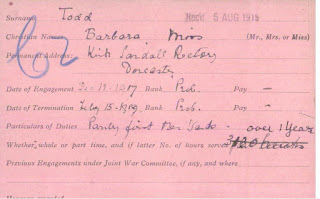
Barbara's Red Cross WW1 record card

Sources:  

https://vad.redcross.org.uk/record?rowKey=209361

https://fantastic-writers-and-the-great-war.com/the-writers/barbara-euphan-todd/

https://wartimememoriesproject.com/greatwar/hospitals/hospital.php?pid=1539


Quite by chance a poem recently written by my friend Linda Copp in America, which she posted on Facebook, led me to look for the author of the "Worzel Gummidge" books.  Although Barbara was a poet AND worked as a VAD during WW1, I haven't yet been able to find any WW1 poems by her. If anyone can help please get in touch. 

Linda has very kindly given me permission to share her lovely poem with you:

"The Scarecrow" By Linda Copp ©

Mr. Scarecrow, you're much too meek,

you're much too gentle, mild.

You're much too kind to scare a crow

or even shun, a child.


In your funny coat, patched and bright

bluey-greens, and buttons gold.

You haven't any un-lite' spots,

least none I can behold.


A smile is crayoned cross the broom,

that stands out as your head.

Its bristles point the other way,

beneath a hat of red.


And painted on that one time sweep,

a funny face, a smirk,

It isn't quite that mean enough,

to let the scaring work.


Your laughter seems to change it,

into a silly grin.

Your gentle eyes of charcoal,

reflect a glow within.


And glow is what you must do,

your colors, dress, and face,

They turned you from intended stress,

into the scare's disgrace.


For the crows, they fly above you

they light upon your brow.

It seems they mock and mimic you

but, to their taunts, you mustn't bow.

For the children they all love you,

you're their very best of friend.

You give them light and magic,

from that heart that shines within.


And so, as straw arms reach out,

to children, love and care,

It's really then no wonder,

My scarecrow, you can not scare.


And though you feel a failure,

so often at your job,

You mustn't fall to sighing,

Oh no, You mustn't sob.

For you've achieved a rarer goal,

than once was one day planned,

You've remained yourself, a friend,

straw borders you have spanned.


And no, you needn't worry,

No, you needn't fret,

Though, they can't see your troubled heart,

broken with regret.

Sunshine, is your master.

Scariness is your foe.

The worlds demands you shackled,

by a heart too kind to know,

That cold and darkness have to be,

a part of any day,

That warmth and sunshine often are lost,

forgotten in their way.


Now, though they call you Scarecrow

there's no villain in your soul.

You've failed at what their names implied

but are names the only goal?


For you're one who has to laugh and sing, 

scary things, you cannot do.

You have to cheer the dreary skies.

You have to turn them blue.

You can't conceal that silly smile,

that wants to be a friend.

You can't be mean and angry,

you can't a teardrop lend.


No, no, my friend, you mustn't cry.

You mustn't feel you've failed.

For, in the end, you did what's right,

your inner self prevailed.


And this is much more a victory,

then you can now, believe.

You've done a harder, wiser, task,

than any crow, could leave.

Pumpkins, children, and the like

kiss you on this morn.


Thank you for your silly mask,

that couldn't hurt and scorn.

And bless you for your loving heart,

your hand a golden glove,

That managed to maintain the touch

that harvested such love!


By Linda A. Copp © 1970

WORZEL GUMMIDGE

“Worzel Gummidge” - a British television fantasy comedy series, produced by Southern Television for ITV, based on the Worzel Gummidge books by English author Barbara Euphan Todd. The programme starred Jon Pertwee as the titular scarecrow and Una Stubbs as Aunt Sally. It ran for four series in the UK from 1979 to 1981. On a countdown of the greatest British children's programmes, this series was number 50 in the 50 Greatest Kids TV Shows on Channel 5 on 8 November 2013. "Worzel's Song", sung by Jon Pertwee, was released in 1980, reaching number 33 in the UK charts.


Channel 4 reprised the show in 1987 as Worzel Gummidge Down Under, which was set in New Zealand.

A 2019 series starring Mackenzie Crook (photo right) as Wurzel, was produced by Leopard Pictures and broadcast by BBC One on 26 and 27 December 2019. Mackenzie Crook also wrote and directed the series. A third episode was announced as in production by the BBC on 8 September 2020, and was broadcast on Christmas Eve 2020.

A fourth episode had been set to broadcast in 2020 but production ceased due to the COVID-19 pandemic. That episode was broadcast on 6 November 2021, with two further episodes broadcast on the BBC in late December 2021.

https://www.imdb.com/title/tt10516874/

Monday, 16 October 2023

Mary E. Bond (1897 - 1988) – student poet of WW1

With thanks to Historian Andrew Mackay for finding this poem and poet for us.

Postcard with Mary's poem - sold in aid of
WW1 soldiers' comforts and printed
in Blackburn, Lancashire.

Born in Oswaldtwistle, Lancashire, UK in November 1897,  Mary's parents were Charles Bond, a coalminer, and his wife, Annie Bond, who was born in Ireland.  The family lived in Oswaldtwistle, Blackburn, Lancashire.  

Mary Ellen Bond was a student at the time of writing this poem and attended Bank Top Congregational Sunday School.  

Mary died in 1988 in Blackburn, Lancashire.  

If anyone has any further information about Mary, has a photograph and/or knows if she wrote any other poems please get in touch.

Bank Top is in Blackburn with Darwen in the County of Lancashire, United Kingdom.

Soldiers’ Comforts 

Almost 18,000 charities were set up to assist people during the First World War.  


Sources:

Postcard from Andrew Mackay,  
Find my Past website
https://www.thirdsector.co.uk/1914-1918-charities-helped-win-ww1/volunteering/article/1299786
https://www.salvationarmy.org.uk/about-us/international-heritage-centre/international-heritage-centre-blog/new-kind-help-comforts-first-world-war

Friday, 13 October 2023

Florence A. Vicars (1870 - ? ) – Poet

While researching another WW1 poet with a similar name - Ambrose Vickers - I noticed an entry in Catherine W. Reilly's "English Poetry of the First World War: A Bibliography" on page 322 about Florence A. Vicars.  

Unfortunately, I have not been able to find out much about Florence.  According to an entry I found through the Find my Past website, she was born in England and married an Irishman called Joseph J.S. Vickars, who was born in Ireland in 1845.  They seem to have travelled to Canada in 1911.  And there is an entry on the 1911 Census in Canada that lists them as living in Toronto West, Ontario.  If anyone knows anything about Florence please get in touch.

Here is one of Florence's poems:

“GOLD STRIPES A Canadian Mother Speaks”

My Bert 'as just come 'ome again ; 'e walks a little lame, 

But thank the Lord 'e's got 'is eyes, 'is face is just the same ; 

I'm that glad the shrapnel miss'd it, I could look at 'im all day, 

Though I'd love 'im just as dearly if the 'al was shot away.

'E ain't so reg'lar 'andsome, and 'e ain't so ugly too, 

But just an average looker, the same as me and you. 

And there's not a prouder woman in Alberta, I believe, 

When I go out walkin' with 'im, with the gold stripes on 'is sleeve.


There's one 'e says 'e got by bein' just a bloomin' fool ; 

Fair mad 'e was that day the Boches bombed an infant school. 

There was cover for the takin', but 'e couldn't stop to take it; 

Through blood and tears 'e saw their line, and knew 'e 'ad to break it.

The other times, 'e says, 'twas just 'is duty that 'e done, 

And, once, I know, the orficers they thank'd 'im one by one.

So every day I thank the Lord for what we do receive, 

When I walk with Bert in khaki, with the gold stripes on 'is sleeve.

FLORENCE A. VICARS. The Westminster Gazette.


Published in  “WAR VERSE” EDITED BY FRANK FOXCROFT (THOMAS Y. CROWELL COMPANY, NEW YORK , 1918) - p. 127

https://archive.org/details/warverse027439mbp    That poem was allso published in the “Yorkshire Evening Post”, Friday 30 November 1917 

Here is another of Florence's poems:

“Springtime in England A Memory of Exile” by Florence A Vicars, Toronto, 1916 published in the “Westminster Gazette” 4th May 1916. 


Sources: Find my Past, British Newspaper Archive 

https://archive.org/details/warverse027439mbp 

and

Catherine W. Reilly.- "English Poetry of the First World War: A Bibliography" (St. Martin's Press, New York, 1978) - page 322


Tuesday, 3 October 2023

Ruth Collie, née Ruth Jacobs, (1888 - 1936) - British-born poet who started her writing career in Winnipeg, Manitoba – whose pen names were Wilhelmina Stitch and Sheila Rand

With thanks to Stanley Kaye (the Poppy Man) for finding this poet for us.  

Ruth Jacobs was born in November 1888 in Cambridge, UK. She was the eldest of three children born to Isiah Wolf Jacobs, a bookseller and accountant, and his wife, Josephine Jacobs, nee Hast. Her maternal grandfather was Marcus Hast, a Hebrew composer who spent 40 years as Rabbi at the Great Synagogue of London.

In 1908, Ruth's future husband, Elisha Arakie Cohen, a lawyer who worked for the firm Daly, Crichton and McClure in Winnipeg, Manitoba, Canada, travelled to England where he met  Ruth. They were married and returned to Winnipeg. In 1910 their son - Ralph - was born.

In 1913, Ruth began writing book reviews for the “Winnipeg Telegram” using the pen name Sheila Rand. In 1917 she was hired as an editor and regularly published poems and short stories. By January 1919, the “Telegram” was in financial trouble and she was recruited by the “Winnipeg Tribune”, where she started to write a column called "What to Read... and What Not." The column included book reviews and also poems she wrote. 

Following the death of her husband in March 1919, Ruth began working at Eaton's, writing advertising copy for their catalogues. She continued to write for the “Tribune” and became literary editor of “Western Home Monthly”. She was also elected vice-president of the Canadian Authors' Association, which led to regular speaking engagements. In 1922, Ruth signed a deal to publish her poetry in several North American newspapers and began to write under a new pen name, Wilhelmina Stitch.

In 1923 Ruth moved back to England to further her son's education. He became a  professor of economics. In 1924, she married Frank Collie, a physician from Scotland. Ruth resumed her writing career and submitted poetry to the “London Daily Graphic”. Her daily poetry earned her the nickname, "the poem a day lady." Her poetry made her name well known and she was regularly called on to speak for community groups. In 1930, Ruth went on a two-month speaking tour of North America where she spoke every day for 50 days.

Ruth died in London in 1936 after a brief illness at the age of 48. 

Memorial plaque dedicated to Ruth Collie under her pen name Wilhelmina Stitch at Golders Green Crematorium. Photograph by Stanley Kaye. 

"TO ONE WHO DIED IN ACTION"

FOR thirteen years, 

Each first of June, 

We marked our heights upon the schoolroom door. 

With girlish jeers, 

Each first of June, 

I scoffed, O cousin, you must grow still more 

If you would be as tall as I 

Next first of June ! 

My solemn, pale-faced cousin, Fie ! 

To let me win the race. 


Ah me! To-day, 

This first of June, 

They wrote that you in Flanders found a grave. 

So now I say, 

This first of June,   

‘O pale-faced cousin, sleeping with the brave, 

Would I could grow as tall as you 

Next first of June, 

And stride, as British heroes do, 

With head above the clouds!’ 


From: “Canadian Poems of the Great War.” Edited by John W. Garvin, (McClelland & Stewart, Toronto, 1918) – page 184. 

As this WW1 Anthology is available to read as a free download on Archive, you can also read other poems by Ruth published in that volume on pages 183 – 186. 

https://archive.org/details/canadianpoems00garvuoft/page/184/mode/2up

Other sources:  Find my Past, Free BMD and Wikipedia. 

http://www.echenberg.org/war-poetry.com_oldsite/_data/authorpaginated/details/63960.html

Portrait of Ruth taken  by Howard Coster National Portrait Gallery NPG x93858

https://www.npg.org.uk/collections/search/portrait/mw54152/Wilhelmina-Stitch-Ruth-Collie

Howard Sydney Musgrave Coster (27 April 1885 – 17 November 1959) was a British photographer. After serving in the RAF during WW1, he opened a studio in London in 1926. 


Friday, 21 July 2023

Enid B. Petre (1890 - 1962) – Britsh poet


With grateful thanks to Historian, Writer and Poet AC Benus* for reminding me that, although Enid Petre was already on the List of Female Poets of the First World War, I had not yet researched and written  a post about her.  


Enid Beatrice Petre was born on 3rd March 1890 in Aligarh, Bengal, India. Her parents were Francis Loraine Petre, a civil servant who worked in India, and his wife, Maude Ellen Petre, nee Rawlinson, who were married in Bengal in 1887. 

In the 1901 England, Wales & Scotland Census, the family were living at No. 27, Gledhow Gardens, Kensington, London, UK.  


During the First World War, Enid served as a nurse with the British Red Cross as a VAD from 19th November 1917 until 28th February 1918.   According to her WW1 British Red Cross VAD Record Card, it seems that Enid worked at the Royal Free Military Hospital in London.


On the 1921 Census, Enid is recorded as living at No. 25 Golborne Street in Kensington, London, UK.  

Enid died on 13th October 1962.

Enid’s WW1 poetry collections were:

“Autumn Leaves, 1915” (A.L. Humphreys, 1916)

“Fallen Petals: Poems” (A.L. Humphreys, 1917)

Sources:  Find my Past

https://www.thepeerage.com/p4944.htm

https://vad.redcross.org.uk/search

https://www.wartimememoriesproject.com/greatwar/hospitals/hospital.php?pid=13853

Catherine W. Reilly, “English Poetry of the First World War: A Bibliography” (St. Martin’s Press, New York, 1978) p. 252

*AC Benus is the author of a book about German WW1 poet Hans Ehrenbaum-Degele : “The Thousandth Regiment: A Translation of and Commentary on Hans Ehrenbaum-Degele’s War Poems” by AC Benus (AC Benus, San Francisco, 2020). Along with Hans's story, the book includes original poems as well as translations.    ISBN: 978-1657220584

https://www.amazon.co.uk/dp/1657220583


Saturday, 1 July 2023

Daisy Minnie Hannah Jones (1895 - 1980) – British poet

 A wonderful poem posted on the Facebook Group Cemeteries and Memorials of the Great War by Dave Barlee, on 26 June 2023 


Dave is Daisy’s grandson.  He gave me permission and sent me some poems plus some information about and a photograph of Daisy.  Dave tells us:

“Daisy penned this poem in September 1914 to my grandfather, William John Jones, 1st Battalion Grenadier Guards:

“To W.J.J.”

When across the foaming billows

To a near, but foreign shore

When with all equipment laden

You are marching off to war :-

N’ere forget that one is thinking

Thinking of you far away

Praying that from midst wars rampant 

Safely you’ll return one day

x x x x x x 

When you are in the midst of dangers

And around you comrades fall

When with still undaunted courage 

You are answering duty’s call

Think that there’s one in England 

Who doth for you wait, and pray

That through all encircling dangers 

Safely you’ll return one day

x x x x x x 

When the war at last is ended

And the longed for reign of peace

Over- throws his welcome mantle

And the noise of battles cease:-

Even then shall one be thinking

Thinking of you day by day

Counting how long you’ll be coming

From the war field far away

x x x x x x

A poem from Daisy's notebook
in her own handwriting

Born Daisy Minnie Hannah Cook in Epsom in 1895, when Daisy left school she went into service. She was 19 when she wrote to William John Jones, who had been called back to the colours at the start of the war. I’m not sure where she met him as he was from Neath in South Wales. I presume it must have been when he was in the London area when he joined the Grenadier Guards.

William had served his time by 1916 and was discharged and continued with his job as a steel worker. They moved to Deeside, Flinshire, North Wales. After the death of William, Daisy remarried and became Daisy Thomas. She died in Flintshire in 1980.  

Grandmother was fantastic with her hands and made lace and could do macrame and tatting and was a seamstress too. As I said - a clever lady! 

She wrote quite a lot of poetry in her younger days. The above poems are related to the Great War.”

Additional information:

We find Daisy, married to William John Jones, living in Flintshire, Wales.  By then the couple had a son – Elwyn Idris - and a daughter – Glenys May. 

Original source:

https://www.facebook.com/groups/1609379815967794/posts/3439766769595747/?comment_id=3439806112925146&notif_id=1687776804567816&notif_t=group_comment_mentionFacebook Group Cemeteries and Memorials of the Great War 

You can find out more about the importance of cigarettes for the troops fighting on the various Fronts during WW1 here:

https://blog.maryevans.com/2013/11/smokes-for-tommy-cigarettes-and-the-british-soldier-ww1.html


Wednesday, 17 May 2023

Ruth Pitter, CBE (1897 - 1992) – British poet and artist


Ruth was born Emma Thomas Ruth Pitter in Ilford, Essex, UK on 7th November 1897. However, her birth certificate records her Christian name as just being "Ruth."  Her parents were George Pitter and his wife, Louisa Pitter, nee Murrell, who were both primary school teachers.  Ruth was educated at the Coborn School for Girls in London. 

During the First World War, Ruth was employed at the War Office from 1915 to 1917. She went on to work as an artist at a furniture company in Suffolk -Walberswick Peasant Pottery Co.

Ruth’s parents encouraged her to write poetry from an early age.  In 1920, she published her first collection of poems – “First Poems” (London: Cecil Palmer, 1920) - with the help of the poet Hilaire Belloc.

Ruth was the first woman to receive the Queen's Gold Medal for Poetry, which she was awarded in 1955. In 1979 she was appointed appointed Commander of the Most Excellent Order of the British Empire (CBE), to honour her many contributions to English literature.  In 1974, Ruth was named a "Companion of Literature", the highest honour given by the Royal Society of Literature.

After a long and very industrious life during which she published a good deal of her poems, Ruth died on 29th February 1992.

(NOTE; Prisca Coborn or Cobourne (1622-1701), the widow of a Bow brewer, left property at Bow, Stratford, and Bocking (Essex) to maintain a school for not more than 50 poor children at Bow; the boys were to learn reading, writing, and accounts, and the girls reading, writing, and needlework. The Coopers' Girls' School at 86 Bow Road was renamed Coborn School and moved to new buildings at 31-33 Bow Road, London, E 3 in 1898.)

Sources:  Free BMD, Find my Past 

https://www.enitharmon.co.uk/product/ruth-pitter-collected-poems/

http://sites.montreat.edu/faculty/don-king/ruth-pitter-project

https://www.british-history.ac.uk/vch/middx/vol1/p290a


Wednesday, 10 May 2023

Ethel Turner (1870 – 1958) - British-born Australian novelist, poet and children's literature writer.

My grateful thanks to Rupert Brooke Remembered on Facebook, for posting the poem about Rupert Brooke written by Ethel , with additional information about Ethel on https://www.facebook.com/rupertbrookepoet which enabled me to amend my previous mentions of Ethel.  


Born Ethel Mary Burwell on 24th January 1870 in Balby, a suburb of Doncaster in South Yorkshire, UK, her parents were Bennett George Burwell, who was a commercial traveller (salesman), and his wife, Sarah Jane Burwell, nee Shaw. Ethel’s father died when she was two, leaving a Sarah Jane a widow with two daughters - Ethel and her sister Lillian, who was born in 1867.  Following her remarriage to Henry Turner, who was 20 years her senior and had six children of his own, Sarah Jane and Henry had a daughter, Rose. Henry Turner died suddenly, leaving Sarah Jane with nine children. In 1879, Sarah Jane moved to Australia with Lilian, Ethel and Rose.  

Educated at Paddington, New South Wales Public School and Sydney Girls High School, Ethel began her writing career when she was eighteen, founding the “Parthenon”, a journal for young people, with her sister Lillian. Using the pen-name 'Dame Durden', Ethel wrote children's columns for the “Illustrated Sydney News” and the “Australian Town and Country Journal”.

In 1896, Ethel married Herbert Curlewis, a lawyer. 

During the First World War (1914-1918) Ethel demonstrated that she was a staunch patriot - she worked hard on patriotic campaigns, including advocacy for conscription, Australian intake of European war orphans and raising funds for soldiers’ homes. 

In 1915, along with other fundraising work, Ethel wrote a song to raise money for the Red Cross.  She also campaigned for the early closing of hotels and “sobriety in wartime” (1915), as well as giving support to the wartime referendum for the 6 o’clock closing of pubs (1916). 

In order to raise money for soldiers returning to Australia after the war, Ethel co-edited “The Australian Soldiers’ Gift Book” with Bertram Stevens (Voluntary Workers' Association, Sydney, N.S.W.,1918).

Ethel died on 8th April 1958 and was buried in Macquarie Park Cemetery in Sydney.

Ethel's poem about WW1 poet Rupert Brooke, which was published in "Poetry Magazine", edited by Harriet Monroe, in June 1924:


Sources: 

Find my Past, FreeBMD

https://www.australianculture.org/ethel-turner/?fbclid=IwAR3kesBNW8j5UOfe0iAGyD6YuEHvl_cuMwfRhXqrsgFlaXXjWsevd1PNF8E

https://www.facebook.com/rupertbrookepoet https://www.awm.gov.au/collection/LIB9106


Monday, 10 April 2023

Ada Tessibel Peters, born c. 1901 and Ethel Pauline Peters, born c. 1903 – American sisters who were both poets

 With grateful thanks to Historian, Poet and Writer AC Benus* for finding these important poets and their poetry for us


The girls’ parents were Robert E. Peters and his wife Ethel Peters, nee Hughes, and the family lived in Beckley, West Virginia., United States of America.    

"The sisters were known in the poetical world as "The Peters Sisters." The Peters Sisters have had very limited education. Each of them spent one and one half years in high school at the Institute. West Virginia. Their teacher was Prof. Byrd Prillerman."

By William F. Denny from The Introduction to their poetry collection “War poems” by Ada Tessibel Peters and Ethel Pauline Peters (Union publishing Co., Charleston, West Virginia, 1919). 

“PREFACE 

The sole intention of the Authors in writing these poems is to show the Negro's loyalty to the Stars and Stripes, in the war with Germany; and to show  the need of unity of all men in the fight for democracy. The Authors.” From the sisters' WW1 collection “War poems” by Ada Tessibel Peters and Ethel Pauline Peters (Union publishing Co., Charleston, West Virginia, 1919) 


OUR WAR WITH GERMANY. Poem by Ada Tessibel Peters

I. 

America and her Allies are now engaged 

In a war that freedom might live, 

That all nations may not be enslaved 

Giving as all True Americans would give 

Fighting lest Germany's Kaiser should spread 

The spirit of feudalism over the earth, 

That the Sons of Liberty may not be led 

Captives from the land of their birth. 

II. 

While foreign field were strewn with dead 

With folded arms we merely looked on 

'Till the wronged people believed and said 

"They are gamblers, in search of coin." 

We became apoligist for our neutriality 

While an uncivilized war waged on 

Devoid of all principle and morality 

Urged on by brutes in human form. 

III. 

When the country of Belgium was invaded 

And It's inhabitants tortured and slain 

When other defenseless towns were raided 

And mines in neutral waters were lain 

When the smoldering ruins of France we saw 

The home of the world's greatest arts 

Then Humanity forced us into this war 

For America too, must do her part. 

IV. 

The Imperial German Government smiled

When the Sussex, and Lusitania went down 

Unwarningly murdering American lives 

While on peaceful missions bound 

Should not this wicked and hideous crime 

That sent our friends to watery graves 

Help more close our hearts to bind 

And strengthen us on our rugged way?

“War Poems” Pages 9 – 10 

read the remainder of the poem – pages 10 – 15  here https://archive.org/details/warpoems00pete/page/10/mode/2up


PEARLS UNRECOGNIZED  Poem by E. P. Peters.

I.

Oh wandering pilgrims of Virginia, 

Who made you noted men. 

Whom was ever your defender. 

And proved old Glory's friend. 

Was it not back in sixteen 

For slaves of your selfish will. 

When your unfree tongues were still, 

You ignorantly bought pearls unseen, 

For slaves of your selfish will. 

II. 

In vales and on historic hills, 

Where your gallant heroes sleep, 

Once Ethiophians your soil tilled, 

From dawn till sunset peace. 

Raised grain and your cattle fed, 

In your business planned and advised, 

Without place to lay their heads 

Your own pearls unrecognized. 

Your own pearls unrecognised.

III. 

From tobacco made you wealthy, 

Your cruelty was humbly borne 

Slave cooks made you healthy,  

Black boys protected your homes, 

With maimed bodies and chained hands, 

Died to make your sons free, 

Rare gems in a slave land. 

Robbed of rights and liberty. 

From “War Poems” page 48). Read the remainder of the poem on pages 49 - 51 here 

https://archive.org/details/warpoems00pete/page/48/mode/2up

Sources:  Find my Past and 

https://archive.org/stream/warpoems00pete/warpoems00pete_djvu.txt

*AC Benus is the author of a book about German WW1 poet Hans Ehrenbaum-Degele : “The Thousandth Regiment: A Translation of and Commentary on Hans Ehrenbaum-Degele’s War Poems” by AC Benus (AC Benus, San Francisco, 2020). Along with Hans's story, the book includes original poems as well as translations.    ISBN: 978-1657220584

https://www.amazon.co.uk/dp/1657220583