Monday, 4 February 2019

Louise Bogan (1897 – 1970) - American poet

The first woman to hold the title of Poet Laureate in America

With thanks to Connie Ruzich for introducing me to Louse and her work.

Louise was born on 11th August 1897 in Livermore Falls, Maine, United States of America.  Her father, who was of Irish origin, was a clerk in a mill.  Louise was educated at the Girls' Latin School in Boston, where she began writing poetry and reading the first issues of “Poetry: A Magazine of Verse”. This led to Louise going to study at Boston University, after which she moved to New York to pursue a career in writing. In 1916, Louise married a soldier. He was posted to Panama during the First World War and after a short stay in Panama, Louise and her daughter returned to America and moved in with Louise's parents. Four years later she was left a widow. Louise’s older brother, Private Charles J. Bogan, served with the 104th Massachusetts Infantry on the Western Front in France and was killed on 17th October 1918.

In 1920 Louise spent a few years in Vienna, leaving her daughter with her parents.  In Vienna, Louise explored her loneliness and her new identity in verse. She returned to New York City and in 1923 her first poetry collection, “Body of This Death: Poems”, was published by McBride and Company, New York.

Louise married the poet Raymond Holden in 1925 but the marriage ended in divorce in 1837.

In 1927, Louise became poetry editor of “The New Yorker” Magazine.

Louise’s poetry was published in “The New Republic”, “The Nation”, “Poetry: A Magazine of Verse”, “Scribner's”, and “Atlantic Monthly”. “Collected Poems: 1923–1953” won Louise the Bollingen award in 1955 as well as an award from the Academy of American Poets in 1959. She was the poetry reviewer of The New Yorker from 1931 until she retired in 1970.

Louise died on 4th February 1970.

Connie Ruzich's commemorative WW1 poetry website is called Behind their Lines - such a clever title - https://behindtheirlines.blogspot.com/2018/09/to-my-brother-killed.html

From "Fifteenth Farewell"

You may have all things from me, save my breath. 
The slight life in my throat will not give pause 
For your love, nor your loss, nor any cause. 
Shall I be made a panderer to death, 
Dig the green ground for darkness underneath, 
Let the dust serve me, covering all that was 
With all that will be? Better, from time's claws, 
The hardened face under the subtle wreath. 

Cooler than stones in wells, sweeter, more kind 
Than hot, perfidious words, my breathing moves 
Close to my plunging blood. Be strong, and hang 
Unriven mist over my breast and mind. 
My breath! We shall forget the heart that loves, 
Though in my body beat its blade, and its fang.

From “Body of this Death: Poems” by Louise Bogan, published by Robert M. McBridge & Company, New York, 1923.

Photo of Louise Bogan from http://www.theotherpages.org/poems/faces.html

Thursday, 31 January 2019

Eva Dobell (1876 – 1963) - British poet and WW1 VAD

Following on from my post on 20th August 2014, here is a little more information about Eva.

Eveline Jessie Dobell, known as Eva, was born on 30th January 1876 in Charlton Kings, Gloucestershire, UK. Her parents were Wine Merhant and local historian Clarence Mason Dobell from Cheltenham, and his wife Emily Ann, nee Duffield.  Victorian poet Sydney Dobell (1824 – 1874) was Eva’s uncle. Eva had the following siblings: Clarence Brian, b. 1870 and Walter Duffield, b. 1872.

Eva joined the Voluntary Aid Detachment (VAD) on 5th November 1914. She served as a nurse at The Priory Hospital, Gloucester, which opened on 5th November 1914.

Eva served during the First World War until 15th November 1917.  Her experiences during WW1 inspired her poetry.


Eva's Red Cross VAD Record Card


The Priory Hospital, Gloucester

After the war, Eva continued to write, publishing poetry collections and a verse drama. She also edited a book of poems by Lady Margaret Sackville.

Eva died in Cheltenham on 3rd September 1963.

Eva’s poetry collection ”A Bunch of Cotswold Grasses: Poems” was published by Stockwell in 1919 and “Verses Old and New” was published by P. Favil in 1959.

Sources:

“English Poetry of the First World War:  A Bibliography” by Catherine W. Reilly (St. Martin’s Press, New York, 1978) p. 112;  Find my Past,  The British Red Cross data base of WW1 VADs and
http://www.remembering.org.uk/vad_priory.htm

Photograph Eva Dobell in uniform, WW1 - photographer unknown reproduced with kind permission of Richard Bomford  from www.bomford.net'

Eva's Red Cross Record Card from the British Red Cross WW1 Archive

"Night Duty" by Eva Dobell

The pain and laughter of the day are done
So strangely hushed and still the long ward seems,
Only the Sister’s candle softly beams.
Clear from the church near by the clock strikes ’one’;
And all are wrapt away in secret sleep and dreams.

Here one cries sudden on a sobbing breath,
Gripped in the clutch of some incarnate fear:
What terror through the darkness draweth near?
What memory of carnage and of death?
What vanished scenes of dread to his closed eyes appear?

And one laughs out with an exultant joy.
An athlete he — Maybe his young limbs strain
In some remembered game, and not in vain
To win his side the goal — Poor crippled boy,
Who in the waking world will never run again.

One murmurs soft and low a woman’s name;
And here a vet’ran soldier calm and still
As sculptured marble sleeps, and roams at will
Through eastern lands where sunbeams scorch like flame,
By rich bazaar and town, and wood-wrapt snow-crowned hill.

Through the wide open window on great star,
Swinging her lamp above the pear-tree high,
Looks in upon these dreaming forms that lie
So near in body, yet in soul so far
As those bright worlds thick strewn ion that vast depth of sky.


Wednesday, 9 January 2019

Lucie Delarue-Mardrus (1874 - 1945) - French

Lucie Delarue-Mardrus was born in Honfleur, on the Normandy Coast in France, the youngest of six children. Her parents were  Georges Delarue, a lawyer, and his wife, Marie Louise, nee Jazet.


Lucie became a talented and prolific poet, writer, journalist, sculptor and designer.  

On 5th June 1900, Lucie married the translator and oriental studies expert Joseph Charles Mardrus and travelled with him to North Africa, Egypt, Turkey, Syria and Italy.   By the time WW1 broke out, Lucie had become famous.

Divorced in 1915, Lucie volunteered as a nurse in Hospital 13 in Honfleur.   After the war she lived and worked in Paris.  Lucie died in Honfleur on 26th April 1945. 


Lines, written by Lucie on 16th August 1914:

Toi mère et toi, ma soeur Marie
Pour moi recitez un Ave
Allons enfants de la patrie
Le jour de gloire est arrivé.

Oh Mother and my sister, Marie
Please say a prayer for me
Come children of our country
The day of glory is here.

Régiments

Tous ces garçons qui sont partis,
Tous ces soldats dressés dans l’horreur de la guerre,
Ils ont été des tout petits
Emmaillotés au chaud dans les bras d’une mère.

Orgueilleux et casqués de fer,
Ils s’en vont vers le bruit de la foudre qu’on lance,
Laissant derrière eux l’autre enfer,
Pauvre enfer féminin des pleurs et du silence.

— Vous avez porté vos enfants,
Mères ! au plus profond de votre chair intime.
Alors, vaincus ou triomphants,
Vous croyez, quand ils sont tués, que c’est un crime.

Moi, voyant défiler ces gas,
J’évoque avec stupeur leur naissance et ses drames,
Et je songe, et je dis tout bas:
« Toutes ces têtes d’homme ont fait mal à des femmes. »

“Regiments”

            All those boys who have left,
These soldiers reared to abominate war,
            Were little babies once, held
Snug and swaddled in a mother’s arms.
           
            All a-swagger in steel helmets,
They march towards the crack of flung lightning,
            And leave behind that other hell,
The sorry female hell of tears and silence.

            Mothers, in your inmost being, deep
Flesh of your flesh, you carried your children;
            For you, victory and defeat
Are one: you hold your children’s death a crime.

            But I just watch these lads march away,
And think in stupefaction of their birth;
            And deep inside myself I say:
‘All these men’s heads have torn women with pain.’
                        — by Lucie Delarue-Mardrus, translated by Ian Higgins

Professor Ian Higgins:  Lucie Delarue-Mardrus “Souffles de tempête” (Fasquelle, 1918). I included it, with a number of others by her (and poems by other female poets), in my Anthology of First World War French Poetry (University of Glasgow French and German Publications, 1996)

Lucie Delarue-Mardrus, Mes Memoires, Gallimard, 1938, p. 196.

Ian says:  I find 'Régiments' very vivid and moving in its simplicity. It's so simple, in fact that the last line is a brute to translate. It really doesn't make explicit reference to being torn; it just says the heads have hurt women. But 'hurt' is so all-encompassing a word that it's quite dilute. In the context of the 'drames' of birth and all those heads bobbing up and down to the rhythm of the march, 'hurt' seems altogether too feeble ('how terribly hurtful'...). 'Given women pain' sounds equally limp-wristed. So I decided I had to produce a particularising translation (i.e. adding explicit detail that's only implicit in the French). Hence the 'torn'. But certainly, if I'd translated it thus as a student in the early 60s, there'd have been a sarcastic red pen put through it!

Mr Ian Higgins, Honorary Senior Lecturer

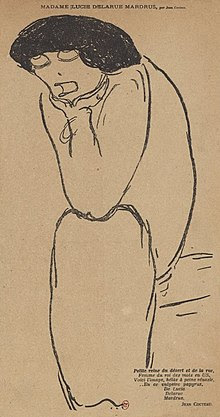
Lucie by Jean Cocteau
(1889 - 1963)


Thursday, 20 December 2018

Margaret Widdemer (1884 - 1978) - American writer and poer

Margaret Widdemer was born in Doylestown, Pennsylvania, USA on 30th September 1884. She was raised and educated in Asbury Park, New Jersey, where her father, Howard T. Widdemer, was a Minister of the First Congregational Church. Margaret graduated from the Drexel Institute Library School in 1909. She first came to public attention with her poem “The Factories” abour child labour.

In 1919, Margaret married Robert Haven Schauffler.  She also won the Pulitzer Prize (known then as the Columbia University Prize) in 1919 for her collection “The Old Road to Paradise”. The Award was shared with writer, poet, editor, singer/songwriter Carl Sandburg for his poetry collection “Cornhuskers”.

Margaret's memoir “Golden Years I Had” recounts her friendships with writers Ezra Pound, F. Scott Fitzgerald, T. S. Eliot, Thornton Wilder, and Edna St. Vincent Millay.

Margaret Widdemer died on 14th July 1978, leaving a legacy of novels, poems and children’s fiction.

“The Old Road to Paradise” https://digital.library.upenn.edu/women/widdemer/paradise/paradise.html

Ours is a dark Easter-tide,
  And a scarlet Spring,
But high up at Heaven-Gate
  All the saints sing,
Glad for the great companies
  Returning to their King.

Oh, in youth the dawn's a rose,
  Dusk's an amethyst,
All the roads from dusk to dawn
  Gay they wind and twist;
The old road to Paradise
  Easy it is missed!

But out on the wet battlefields,
  Few the roadways wind,
One to grief, one to death
  No road that's kind–
The old road to Paradise
  Plain it is to find!

(Martin in his Colonel's cloak,
  Joan in her mail,
David with his crown and sword–
  None there be that fail–
Down the road to Paradise
  Stand to greet and hail!)

Where the dark's a terror-thing,
  Morn a hope doubt-tossed.
Where the lads lie thinking long
  Out in rain and frost,
There they find their God again,
  Long ago they lost:

Where the night comes cruelly,
  Where the hurt men moan,
Where the crushed forgotten ones
  Whisper prayers alone,
Christ along the battlefields
  Comes to lead His own:

Souls that would have withered soon
  In the hot world's glare,
Blown and gone like shriveled things,
  Dusty on the air,
Rank on rank they follow Him,
  Young and strong and fair!

Ours is a sad Easter-tide,
  And a woeful day,
But high up at Heaven-Gate
  The saints are all gay,
For the old road to Paradise,
  That's a crowded way!

Original Source: Catherine W. Reilly "English Poetry of the First World War: A Bibliography" (St. Martin's Press, New York, 1978)

Photograph from: http://mopos15.umwblogs.org/2015/03/02/miranda-schnakenbergs-report-on-margaret-widdemer/

Thursday, 13 December 2018

Edith Nesbit (1858 - 1924) – British writer and poet

Edith is on my list of Female Poets of the First World War because she is listed in Catherine Reilly’s work but I had not yet researched her.  My thanks to Connie Ruzich for her post about one of Edith’s poems (see below) on her weblog https://behindtheirlines.blogspot.com/ which reminded me that I had not yet researched Edith.

Edith Nesbit, who is perhaps best remembered for writing “The Railway Children”, was born in 1858 in Lower Kennington Lane, Kennington, Surrey. This area is now considered to be Inner London.  Edith’s parents were John Collis Nesbit, a chemist, and his wife, Sara Nesbit, nee Green.

Edith’s father died in March 1862. As her sister, Mary, was not in good health, the family travelled for several years and lived in Brighton, in Buckinghamshire, in France, in Spain and in Germany, before settling for three years at Halstead Hall in Halstead in Kent.  When Edith was in her teens, the family moved to Eltham which was in Kent but is now in South London.  They then lived in nearby Lewisham, Grove Park and Lee.

Edith married Hubert Bland, a bank clerk, in April 1880.  The marriage was not a happy one as Hubert had an affair which resulted in the birth of children which Edith adopted.

Edith had the following children: Paul Bland (1880–1940), to whom “The Railway Children was dedicated”; Iris Bland (1881-1950s); Fabian Bland (1885–1900); Rosamund Bland (1886–1950), to whom “The Book of Dragons” was dedicated, and John Bland (1898–1971), to whom “The House of Arden” and “Five Children and It” were dedicated.

After the death of Hubert, Edith married married Thomas "the Skipper" Tucker, whose nick-name referred to the fact that he was the Captain of the Woolwich Ferry.

Edith died in 1924 and was buried in the churchyard of St Mary in the Marsh.

“In Hospital”

Under the shadow of a hawthorn brake,
Where bluebells draw the sky down to the wood,
Where, 'mid brown leaves, the primroses awake
And hidden violets smell of solitude;
Beneath green leaves bright-fluttered by the wing
Of fleeting, beautiful, immortal Spring,
I should have said, 'I love you,' and your eyes
Have said, 'I, too . . . ' The gods saw otherwise.

For this is winter, and the London streets
Are full of soldiers from that far, fierce fray
Where life knows death, and where poor glory meets
Full-face with shame, and weeps and turns away.
And in the broken, trampled foreign wood
Is horror, and the terrible scent of blood,
And love shines tremulous, like a drowning star,
Under the shadow of the wings of war.

First published in “The Westminster Gazette” on 11th December 1915.

Edith’s WW1 collection was entitled “Many Voices – Poems” (Hutchinson, London, 1922).  Her poems were published in four WW1 anthologies.

https://behindtheirlines.blogspot.com/search/label/Nesbit
“English Poetry of the First World War:  A Bibliography” (St. Martin’s Press, New York, 1978) – page 234

Photograph of Edith, photographer unknown, from http://www.edithnesbit.co.uk/childrens.php

Wednesday, 5 December 2018

Elsie Spence Rae (1898 - 1973) – Scottish poet

With many thanks to Dr Alison T. McCall, independent researcher, Kintore, for reminding me that I had not yet researched Elsie.  Dr. McCall has kindly sent me scans of some of Elsie's poems from her collection of WW1 poems.

Elsie was born in Banff, in the Banff and Buchan area of Aberdeenshire, Scotland, on 16th November 1898. Her parents were John S. Rae, a grocer, and his wife Annie.  Elsie had the following siblings:  Annie, Kathy, John, William and Maggie.  Elsie studied at Aberdeen University and during the First World War, she served with the Voluntary Aid Detachment as a nurse.

On 5th April 1921, Elsie married Robert Wilson.

Alison says: “Elsie Rae's poems are a mixture of Doric (broad Scots) and English.” 

Elsie’s WW1 poetry collection is “Private John M’Pherson and other war poems” (Aberdeen Daily Journal Office, Wyllie, Aberdeen, 1918)

Catherine W. Reilly “English Poetry of the First World War:  A Bibliography” (St. Martin’s Press, New York, 1978) p. 260.  Poems from Elsie’s WW1 collection kindly supplied by Alison McCall

Sources:  Find my Past
Aberdeen University Memorial Roll 1914  - 1918)
Catherine W. Reilly “English Poetry of the First World War:  A Bibliography” (St. Martin’s Press, New York, 1978) p. 260.  Information about Elsie's marriage supplied by Dr. McCall.


Wednesday, 3 October 2018

Remembering WW1 female poet Nadja (1895 - 1934) on the 84th anniversary of her death

Today (Wednesday, 3rd October 2018) marks the 84th anniversary of the death of WW1 poet Nadja. 

Born Louisa Nadia Green in Hampstead, UK in 1893, during the First World War, Nadja published three volumes of her poetry to be sold in aid of St. Dunstan's Home for Blind Soldiers (now called Blind Veterans UK) and The Star and Garter Home for Disabled Soldiers. 

In 1922, Nadja married Italian Marquess Pier Malacrida de Saint-August. She died in a motor car accident on her way home to London on Wednesday, 3rd October 1934.

Nadja is included in "Female Poets of the First World War: Volume Two" on pages 34 - 37).

Nadja's WW1 poetry collections were:  

 "Love and War: poems by Nadja" (Humphreys, London 1915)

"For Empire, and other poems" (Humphreys, London, 1916); and 

"The full heart: poems by Nadja" (Humphreys, London, 1919).

With thanks to Professor Brian Murdoch of Stirling University for bringing the work of Nadja to my attention.

In memory of Nadja, we planted a Malmaison Rose which was her favourite flower.

You can find out more about Nadja, who was a member of the 'social elite' in the UK during the 1920s and 1930s here:  https://worldofnadjamalacrida.blogspot.com/