Monday, 25 April 2022

WW1 ANZAC poems by female poets


For ANZAC Day here are some poems.   Interestlying, Billjim – “one who’ll plug for two” – rather than ANZACS was the affectionate name the public had for Australian soldiers in World War I

https://australiansofarabia.wordpress.com/billjim/

 ANZACS by Ethel M. Campbell  (1866-1954) - printed during World War I, the poem was written by 'E.M.C.' - Ethel M. Campbell - in Durban, South Africa in 1917.    Ethel was known for her enthusiastic greetings and farewells of Australian troopships in Durban during World War I. 

What mean these great white ships at sea, ploughing their Eastward tack, / 

Bearing their precious human freight, bringing the spent men back? / 

They mean that Australia has been there, they mean she has played the game, 

And her wonderful sons have won their share of everlasting fame.


AN ANZAC CAP by Jessie Pope (1868 – 1941) 

It hangs on the wall, a trifle battered,

The wire is warped and the lining tattered.

And the leather inside shows speakingly how

It’s been wet with the sweat of a soldier’s brow.


Month after month, through that fierce campaign—

The bitterest fight that was fought in vain—

It was jammed on an Anzac’s lean, brown poll,

As he pierced his way to a glimpse of goal.


Furlong by furlong, aye, inch by inch,

From the sniping shot to the cold-steel, clinch-

Fists, “rough-housing,” any old tools—

He got there each time by “Rafferty rules.”


Till a shell, with his name on, gave him a call—

And that is the tale of the cap on the wall,

But the sequel, though strange, is an equally true one—

Its owner, thank God, is now wearing a new one.

Jessie Pope. published in “Poverty Bay Herald”, 7 March 1916


Anzac by Sylvia Hobday - I have not been able to find anything out about Sylvia.


There’s a Name we’ve learnt to know, and love –

We’ll n’er forget while Heaven’s above,

And the mountains stand, and waters move

O’er Anzac!


The Name was wrought out of blood and fire,

Through sacrifice and in peril dire –

But the Glory rose Beyond and Higher

Of Anzac!


The Anzac Boys are our Empire’s breed.

They are few or words, but great of deed

And true descendants of Britain’s seed,

Each “Anzac”.


They sail’d ’neath Heaven, and found a Hell,

Where many a Hero fought and fell

As the great guns chim’d their booming knell

O’er Anzac.


And some now rest by the changing seas,

By stony shores swept by gale and breeze –

While stars keep watch o’er the sleep of these –

At Anzac.


O! Christ, in Thy Love, look down, and keep

The souls of the slain, in their long sleep,


Thy comfort bring to the Hearts that weep

For Anzac.


The Name shall ring through the Ages long –

A mighty Paean of Epic Song

Echo’d perchance by Angelic Throng –

Of Anzac!

“Cobbers” by Jessie Pope

They were “cobbers,” that’s Anzac for chum.
But it means rather more than we mean –
A friendship that will not succumb,
Though distance or death intervene.
Adventure, success, and mishap
In boyhood they’d shared, so no wonder
They jumped at the chance of a scrap
And booked with the crowd from ”down under.”

In a narrow Gallipoli trench
They chanced upon glimpses of hell,
And a thirst there was nothing to quench
But a deluging downpour of shell;
Perpetual ridges they took,
They charged and they cursed and they shouted,
But nothing their recklessness shook
Till one of the “cobbers” got “outed.”

The other one came back at night,
Exhausted in body and brain,
And groped round the scene of the fight,
But sought for his “cobber” in vain.
His spirit was heavy with grief,
His outlook was sombre and blotted,
But his bayonet brought him relief
Next, morning— and that’s when he “got it.”

Scene: Midday,Victoria street,
An Anzac (in blue) on each side –
A coo-ee, wild, ringing, and sweet –
The taxicabs swerve and divide.
For traffic they don’t care a toss,
There, right in the middle, they’re meeting;
Stay, let’s draw a curtain across
Where the two long-lost “cobbers” are greeting.


Cicely Fox-Smnith was among the very first female poets of WW1 I researched for this commemorative exhibition project.  

“Farewell to ANZAC” by Cicely Fox-Smith (1882 -  1954)

Oh, hump your swag and leave, lads, the ships are in the bay -
We've got our marching orders now, it's time to come away -
And a long good-bye to Anzac Beach - where blood has flowed in vain
For we're leaving it, leaving it, game to fight again!

But some there are will never quit this bleak and bloody shore -
And some that marched and fought with us will fight and march no more;
Their blood has bought till Judgment Day the slopes they stormed so well,
And we're leaving them, leaving them, sleeping where they fell. 

(Leaving them, leaving them - the bravest and the best -
leaving them, leaving them, and maybe glad to rest!
We've done our best with yesterday, to-morrow's still our own -
But we're leaving them, leaving them, sleeping all alone!)

Ay, they are gone beyond it all, the praising and the blame,
And many a man may win renown, but none more fair a fame;
They showed the world Australia's lads knew well the way to die;
And we're leaving them, leaving them, quiet where they lie.

(Leaving them, leaving them, sleeping where they died;
Leaving them, leaving them, in their glory and their pride -
Round the sea and barren land, over them the sky,
Oh, We're leaving them, leaving them, quiet where they lie!) 

Cicely Fox Smith

https://femalewarpoets.blogspot.com/search?q=Cicely+Fox+Smith


Thursday, 7 April 2022

Re-issue of 'Patriot Mothers and other poems' by Evelyn Shillito

Great news!  The poems of Evelyn Shillito (1874 – 1924) have been re-issued.  For further information about Evelyn please see a previousw post on Female Poets of the First World War  http://femalewarpoets.blogspot.com/2022/02/evelyn-mary-shillito-nee-trengrouse.html

Evelyn’s poetry collection, entitled 'Patriot Mothers and other poems', was discovered in a family attic after a hundred years. This is a new 2022 edition of Evelyn’s book, originally published in 1925 by the "Surbiton Times", after her death in 1924. The original book was prefaced by the following note: “Evelyn might have wished to make some emendations in these verses if she had known that they would be printed, but it has been thought better to issue them just as they were left by her.” Evelyn's relative says: "It has been a privilege to review her poems and make just a few adjustments for readers to enjoy, 100 years later."

Here is the link to purchase a copy:

https://www.amazon.co.uk/dp/B09TMTGM83/ref=cm_sw_em_r_mt_dp_HMKPWZBH80NEVN0S6P8Y


Tuesday, 22 March 2022

Frances Chesterton (1869 – 1938) – British writer, poet, lyricist and playwright

Wife of G.K. Chesterton


Frances Blogg
Born Frances Alice Blogg on 28th June 1869, her parents were George William Blogg, a merchant, and his wife, Blanche, nee Keymer.  Frances was the eldest of their seven children, however I have only been able to find five of Frances’s siblings: 

George Alfred Knollys Blogg, b. 10 April 1871

Ethel Laura Blogg, b. 2 May 1872

Helen Colborne Blogg, b. 22 Nov 1873

Gertrude Colborne Blogg, b. 14 May 1875

Rachel Margaret Blogg, b. 1878, d. 1881 


Blanche Blogg had advanced ideas about education and politics and sent the children to one of the first kindergartens in London – the Ladies' School in Fitzroy Square, London - which was run by Rosalie and Minna Praetorius. Frances went on to Notting Hill High School before becoming a pupil/teacher at St. Stephen's College, an Anglican convent, for two years, graduating in 1891. She then became a tutor, and began teaching at the Sunday school in her local Anglican church in Bedford Park.  

Blanche set up a debating society and held meetings in the family home. That is how Frances met G.K. Chesterton. 

Frances Blogg and Gilbert Keith Chesterton were married on 28th June 1901 in St Mary Abbots, Kensington.  Frances was passionate about her husband’s writing, encouraged him and acted as his personal assistant. In 1909 the couple moved to Beaconsfield, Buckinghamshire, where they lived until they died. 

Every Christmas, Frances would write a poem for their Christmas card, one of which - "How far is it to Bethlehem?" - was later published as the hymn "Is It Far To Bethlehem?"

Gilbert Keith and Frances Chesterton

Gilbert died on 14th June 1936, and Frances on 12th December 1938.

The following poem written by Frances was published in “Lest we Forget:  A War Anthology” edited by H.B. Elliott (Jarrolds, London 1915)

“Le Jour des Morts” by Frances Chesterton  (Tr of title - The Day of the Dead)

The day of the dead, the day of the dead,

Down on your knees and pray,

For the souls of the living, the souls of the dying

The souls that have passed away.


And the great bell tolls

For the treasure of souls

Delivered into his hand,

Gabriel, Michael, Uriel reap

Souls as a measure of sand,

Souls from the restless deep,

Souls from the blood-red land.


The day of the dead, the day of the dead,

Down on your knees and pray,

For the souls of the outcast, despised and rejected

The heroes and victors today.


And the great bell rings,

And the great bell swings, 

As death makes up the number

Of men’s lives as grains of sand.

From the decks their bodies cumber,

From the panting, shivering land,

From crash and shriek to slumber.


The day of the dead, the day of the dead,

Up on your feet and stand 

For the souls of the living, the fighting, the striving,

For the gun and the sword in hand.


And His Transfiguration 

Descends on a nation

And death is a little thing,

And lives as a grain of sand.

Michael, Gabriel, Uriel bring 

From the desolate blood-red land,

From the tall ships foundering


The day of the dead, the day of the dead,

Down on your knees and pray,

For the souls of the living, the souls of the dying,

The souls that have passed away.


From “Lest we Forget:  A War Anthology”, edited by H.B. Elliott (Jarrolds, London 1915) pp. 25 and 26.  This is available to read as a free download on Archive:https://archive.org/details/lestweforget00chesuoft/page/n29/mode/2up

NOTE: The Day of the Dead is traditionally celebrated annually on 1st and 2nd November, although other days, such as 31st October or 6th November, may be included depending on the locality.


Friday, 11 March 2022

Cicely Mary Hamilton (1872 – 1952) – poet, actress, writer, playwright, journalist, suffragist

Cicely by Lena Connell
1910
Cicely Mary Hammill was born on 15th June 1872, in Paddington, London, UK.  Her parents were Maude Mary Florence Hammill, nee Piers, and Denzil Hammill, a British Army Officer.   Cicely had three younger siblings, a sister - Evelyn Maud, b. 1873 - and two brothers – John Eustace, b. 1875 and Charles Raymond, b. 1879.

Educated initially at a boarding school in Malvern, Worcestershire, a cousin of her father’s then paid for Cicely to continue her education at a school in Bad Homburg vor der Höhe, Germany, where she learnt German.  

Cicely became a teacher and taught at a school in the West Midland.  She then joined a touring theatrical company as an actress, taking the stage/pen name "Cicely Hamilton" out of consideration for her family. 

In 1908, Cicely and fellow actress Bessie Hatton founded the Women Writers' Suffrage League, which attracted around 400 members.  Among the members were Ivy Compton-Burnett, Sarah Grand, Violet Hunt, Marie Belloc Lowndes, Alice Meynell, Olive Schreiner, Evelyn Sharp, May Sinclair and Margaret L. Woods.  

The League produced campaigning literature, written by May Sinclair amongst others, and also recruited many prominent male supporters.

"The March of the Women" – the Suffragette’s song - was composed by Ethel Smyth in 1910 with words written by Cicely. 

During the First World War, Cicely joined a unit of the Scottish Women's Hospitals and worked in France.  She went on to join the Women's Auxiliary Army Corps (WAAC) and after training took command of a postal unit in France.   

Due to her acting experience, Cicely also joined a troupe entertaining the troops. The Women Writers Suffrage League helped establish a library at Endell Street Military Hospital, and helped organise recreation at the hospital, which was run and staffed entirely by women.  

Cicely’s brother, Charles Raymond Hammill, who went to live in Australia, joined the Australian Army, AIF and was wounded in May 1917 at the Battle of Bullecourt.  After recovering, he served under Monash with the 4th Battalion of the AIF during the advance on Hargicourt and was killed on 18th September 1918 – his 39th birthday. 

After a career in journalism and writing playes, Cicely died in Chelsea, London, UK on 6th December 1952.

One of Cicely’s most famous plays is “Diana of Dobson’s” about women who worked in a department store. 

Cicely had a poem published in five WW1 anthologies, of which this is one:


From “Lest we forget: A War Anthology” compiled by H.B. Elliott (Jarrold, London, 1915) with a Foreword by Baroness Orczy pp. 117 - 118

NOTE:  Ethel Smyth composed the music for "The March  of the Women" in 1910, as a unison song with optional piano accompaniment, with words by Cicely Hamilton. Ethel based the melody on a traditional tune she had heard in Abruzzo, Italy and dedicated the song to the Women's Social and Political Union (WSPU). In January 1911, the WSPU's newspaper, “Votes for Women”, described the song as "at once a hymn and a call to battle". Ethel did not agree with the support Emmeline Pankhurst and her daughter Christabel gave to the war effort in 1914, but nevertheless, she trained as a radiographer in Paris. 

Ethel Smyth by John Singer
Sargent

"The March of the Women" was first performed on 21st January 1911, by the Suffrage Choir, at a ceremony held on Pall Mall in London, UK, to celebrate the release of some activists from prison. 

Emmeline Pankhurst introduced the song as the WSPU's official anthem, replacing "The Women's Marseillaise", a setting of words by WSPU activist Florence Macaulay to the tune of La Marseillaise.

In 1922, Ethel became the first female composer to be appointed D.B.E. for services to music, becoming known as Dame Ethel Smyth.

https://www.youtube.com/watch?v=LCtGkCg7trY


Sources:

Catherine W. Reilly.-   “English Poetry of the First World War: A Bibliography” (St. Martin’s Press, New York, 1978) p. 155 

https://books.google.co.uk/books?id=2F8sljkVi9wC&pg=PA61&lpg=PA61&dq=denzil+hammill&source=bl&ots=afztlu5eR8&sig=ACfU3U04jv1299FTSrjsUFYq8IqEGgO3cQ&hl=fr&sa=X&ved=2ahUKEwiT2c6Ms7z2AhVCZMAKHVg6CusQ6AF6BAgWEAM#v=onepage&q=denzil%20hammill&f=false

https://fantastic-writers-and-the-great-war.com/the-writers/cicely-hamilton/

“Lest we forget: A War Anthology” compiled by H.B. Elliott (Jarrold, London, 1915) 


Saturday, 5 February 2022

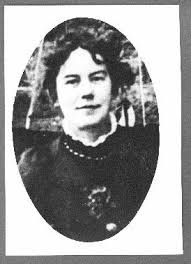
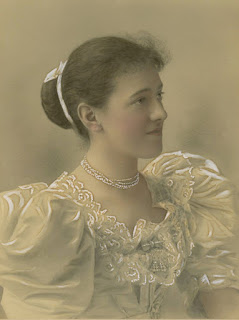
Evelyn Mary Shillito, nee Trengrouse (1874 – 1924) – British poet

With thanks to Lynn Shillito, who is married to Evelyn's Great-Grandson, for contacting me and telling me about Evelyn and sharing her poetry collection with me.

Evelyn Mary Trengrouse was born in Mortlake, Surrey, UK in 1874 to Henry Trengrouse and his wife Mary, nee Walrond.  Evelyn was baptised on 15th May 1874.  Evelyn’s siblings were Henry T. Trengrouse, Louisa C. Trengrouse, Mabel W. Trengrouse and Arthur P. Trengrouse. 

On 5th July 1893, Evelyn married the Reverend William Francis Shillito. The couple had the following children: Dorothy Mary Shillito, James Trueman Shillito and Marjorie Constance Shillito.

During the First World War, Evelyn and her daughter, Dorothy helped the war effort by caring for the sick and wounded. 

Lynn Shillito is in the process of editing a new edition of  the collection of poems by Evelyn Shillito published in 1925 by “The Surbiton Times” with the title “'Patriot Mothers and other Poems”, after her untimely death in December 1924. 

Lynn says:

I have had the privilege of reviewing Evelyn’s poems, making just a few slight changes, and rearranging them into an appropriate order. Many of the themes are just as relevant today as they were in 1921, so it is a pleasure to freshen them up for today's readers to enjoy, 100 years later.

Through her poems we learn of the times in which she lived and of her dreams and her fears, written with such honesty and clarity; none more so than during and after the First World War. Her son Jim served in France in the 'Great War' (1914-1918), while back in the Home Counties, Evelyn and her daughter Dorothy were taking care of the sick and wounded with the British Red Cross. In her poems, Evelyn occasionally refers to Jim as John and to her younger daughter Marjorie as May.

​It is possible that Mrs. Shillito might have wished to make some emendations in these verses if she had known that they would be printed, but it has been thought better to issue them just as they were left by her.

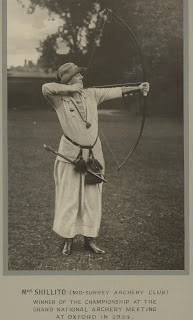
Archery Champion, Oxford
1924
The family have always had an interest in family history.  Once the ancestral boxes came out of the attic, I knew I had a job to do. Delving into Evelyn's life has been really enjoyable. As a family we knew and talked about her Archery winnings, a poetry book was quietly mentioned, along with a Christmas carol, (which we had recorded in December 2021). 

Lynn Shillito, 2021

One of Evelyn's poems:

“O THEE — SOMEWHERE IN FRANCE”

Beloved! Now so far from me, alas!

My thoughts stretch out to bridge the rolling sea

Between us, that in spirit I may pass —

Communion sweet, awhile, to hold with thee.


The superstitious sailor, I am told,

Above all other things a caul doth prize,

Because he thinks ’twill save him from a cold

And watery death, if sudden storms arise.


And though I smile at the credulity,

Which prompts a man to carry such a charm;

Fond dreams and tender fancies come to me,

Born of my wish to shelter thee from harm.


Would I might weave, upon the loom of prayer,

With warp of love and woof of ardent zeal,

A web, invisible and light as air,

Fine as a silken thread, yet strong as steel.


For of such fabric, I would make a shield

An all protective covering for thee

The which should keep thee safe on battlefield

And help thee to confound the enemy.

Evelyn Mary Shillito, June 1918.

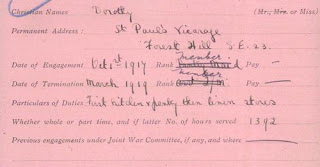
Evelyn's daughter Dorothy Shillito
WW1 Voluntary Aid Detachment (V.A.D.)
British Red Cross Record Card

Photographs of Evelyn kindly supplied by Lynn Shillito.

Sources for additional information: Find my Past, Free BMD and British Red Cross WW1 website      


Friday, 31 December 2021

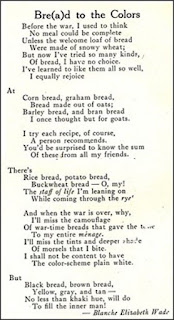
Blanche Elizabeth Wade (1872 - ?) American author and poet

With thanks to Philippe Clerbout who very kindly found this WW1 poem for us.


The poem, entitled “Bre(a)d to the Colors”, was written by Blanche Elizabeth Wade and published in the June/July, 1918 issue of "American Cookery" magazine. As far as I can ascertain, Blanche was the only daughter of American author, poet and pictorial photographer Elizabeth Flint Wade (1849–1915) - Flint being her maiden name - and her husband, Frank Abernathy Wade.  Blanche Elizabeth was born in 1872 and became the author of several popular books.

"American Cookery" was a monthly (except for July and August) journal published in New York, USA that began publishing under that title in 1914, succeeding "The Boston Cooking School Magazine of Culinary Science and Domestic Economics" and continuing its volume numbering. It ran until 1946.

If anyone knows more about Blanche Elizabeth Wade please get in touch.


Friday, 10 December 2021

Emma Backhouse (1860 - 1946) - British poet

With thanks to Chris Dubbs for finding out when Tom went to America

and which of his brother accompanied him.

I am currently reading a very interesting book called “Reported Missing in the Great War: 100 years of searching for the truth” by John Broom (Pen & Sword Military, 2020). There, I discovered a female poet hitherto unknown to me - Emma Backhouse.  

Emma was born Emma Tate on 16th October 1860 in Shadwell, Yorkshire, UK. She married William Backhouse, a coal and clay miner, in Leeds in December 1881 and the couple had 8 children. Two of their sons - Tom - b. 1885 or 1886, and George Harry, b. circa 1890 - went to live in the United States of America and became naturalised citizens in 1913.  

Tom Backhouse joined the American forces in WW1 and was  killed in action while serving in the Argonne with the 325 Infantry, 82nd Division of the U.S. Army.  (pp. 36 – 38).   His body was repatriated to Britain because he served with the U.S. Army - which is why he was included in the book.  

I am trying to find out more about Emma and her family.  During WW1 Emma wrote poems “which she had printed on postcards and sold to passers-by in Leeds city centre.  The money she raised was used to fund three spinal chairs and a bed rest in Seacroft Hospital for convalescing soldiers  Her work “won widespread praise, including letters from Princess Mary, the Prince of Wales and Lord Kitchener”.  

Here is an extract from one of Emma's wartime poems:

from “Lest we Forget” written by Emma Backhouse in 1917 

This is no time for dreaming,

No time for idle scorn;

All should be up and doing,

To cheer some heart folorn

For while our lads are fighting

On land and sea to-day,

Our thoughts should all be centred,

On each one far away

Dear friends I often wonder

When you pass through City Square,

If you notice all the heroes

That are oft assembled there?

Have you watched our gallant heroes,

How they smile and murmur not?

Tis out duty now to help them,

They should never be forgot.


I am hoping to find further information and if possible a photograph. If anyone can help please get in touch.

With grateful thanks to Chris Dubbs for finding out which of Tom's brothers accompanied him to America., and confirming that he joined the American Army in WW1.  Shris Dubbs is the author of two books about American women journalists in WW1:


and "American Women Report World War 1".