Tuesday, 25 October 2022

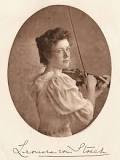
Leonora Speyer, Lady Speyer (1872 – 1956) - American poet and violinist

Leonora Stosch
Born in Washington, D.C., U.S.A., on 7th November 1872,  Leonora was the daughter of Count Ferdinand von Stosch of Mantze in Silesia, who fought for the Union during the Civil War, and his wife, Julia, nee Schayer, who was a writer from New England.  Leonora learnt to play the violin as a little girl.  She then studied music in Brussels, Paris, and Leipzig and went on to play the violin professionally.  

Leonora's first husband was Louis Meredith Howland, who she married in 1894, but they divorced in Paris. In 1902, Leonora married London banker Edgar Speyer (later Sir Edgar), in St. George’s Hanover Square, London. The couple lived in Cavendish Square W, St Marylebone, London until 1915.   Leonora had four daughters: Enid Howland with her first husband and Pamela, Leonora, and Vivien Claire Speyer with Sir Edgar.

Sir Edgar's family were of German origin and, following anti-German attacks on him during the First World War, the couple moved to the United States of America and lived in New York, where Leonora began writing poetry.  She won the 1927 Pulitzer Prize for Poetry for her collection of poetry entitled “Fiddler's Farewell”.


Here is one of Leonora's poems:

“April on the Battlefields”

April now walks the fields again,

Trailing her tearful leaves

And holding all her frightened buds against her heart:

Wrapt in her clouds and mists,

She walks,

Groping her way among the graves of men.


The green of earth is differently green,

A dreadful knowledge trembles in the grass,

And little wide-eyed flowers die too soon:

There is a stillness here —

After a terror of all raving sounds —

And birds sit close for comfort upon the boughs

Of broken trees.


April, thou grief!

What of thy sun and glad, high wind,

Thy valiant hills and woods and eager brooks,

Thy thousand-petalled hopes?

The sky forbids thee sorrow, April!

And yet —

I see thee walking listlessly

Across those scars that once were joyous sod,

Those graves,

Those stepping-stones from life to life.


Death is an interruption between two heart-beats,    


That I know —

Yet know not how I know —

But April mourns,

Trailing her tender green,

The passion of her green,

Across the passion of those fearful fields.


Yes, all the fields!

No barrier here,

No challenge in the night,

No stranger-land;

She passes with her perfect countersign,

Her green;

She wanders in her mournful garden,

Dropping her buds like tears,

Spreading her lovely grief upon the graves of man.

From “The Second Book of Modern Verse: A Selection from the work of contemporaneous American poets”. Edited by Jessie B. Rittenhous,Editor of “The Little Book of Modern Verse”, 1919.


Portrait of Lady Speyer, 1907
by John Singer Sargent (1856 – 1925) 

Sources:

Leonora is mentioned in 
https://archive.org/stream/bellman2619edga/bellman2619edga_djvu.txt

https://web.archive.org/web/20091022183953/http://geocities.com/~bblair/bav22_5.htm

https://www.beltwaypoetry.com/speyer-leonora/

http://www.jssgallery.org/Paintings/LadySpeyer.html


Saturday, 22 October 2022

Radclyffe Hall (12 August 1880 – 7 October 1943) - British poet and writer

Radclyffe Hall, 1918

Marguerite Antonia Raclyffe-Hall was born on 12th August 1880 in Bournemouth, Dorset.  Her parents were Radclyffe Radclyffe-Hall and his wife Mary Jane Sager, nee Diehl.  Her father died in 1898, leaving her a considerable inheritance and she did not get on with her mother and, thanks to her father, was able to go her own way. 

Radclyffe spent time travelling and learning and published five books of poetry between 1906 and 1915, when her collection entitled “The Forgotten Island” was published.

During the First World War, Radclyffe apparently worked with the Red Cross but I cannot find any information about her wartime service.

Although the following poem was published prior to the First World War, I feel it is relevant:


"ON A BATTLE FIELD"

Battle of Tanga, 1914
Martin Frost 

Once o'er this hill whereon we stand,

Just you and I, hand clasp'd in hand

Amid the silence, and the space,

A mighty battle rent the air,

With dying curse and choking prayer;

'Mid shot and shell death stalked apace.


Is it conceivable to you —

So much at peace — because we two

Are close together, or to me?

The silent beauty of the noon

Seems like a Heaven-granted boon,

Aglow with tender ecstasy.


A little mist of hazy blue

Is slowly hiding from our view

The city's domes and slender spires,

As thro' a bridal veil the sun

Subdued and shy lights one by one

The virgin clouds with blushing fires.


The wind has fallen; very low

We hear his wings brush past, and know

He creeps away to dream and rest;

How sweet to be alone, to feel

You breathe one longing sigh, and steal

A little closer to my breast.


Is anything worth while but this?

We may not perish for a kiss,

Yet thus it were not hard to die!

War strews the earth with countless dead,

And after all is done and said,

The end is love, and you and I!


https://www.gutenberg.org/cache/epub/49321/pg49321-images.html

Portrait of Radclyffe Hall in 1918 by German-Born British artist Charles Buchel (Karl August Büchel) (1872–1950)

German artist Martin Frost (1875-1928) produced about 260 paintings and sketches of the German experience of The First World War. His paintings showing the realism of combat put him in the forefront of German war artists of WW1.  Periodicals at the time heavily promoted Frost's works, bringing to the German public the ordeal of the frontline soldier.

The Battle of Tanga, sometimes also known as the Battle of the Bees, was the unsuccessful attack by the British Indian Expeditionary Force "B" under Major General A. E. Aitken to capture German East Africa (the mainland portion of present-day Tanzania) during the First World War. It was the first major event of the war in Eastern Africa and saw the British defeated by a significantly smaller force of German Askaris and colonial volunteers under Lieutenant Colonel Paul von Lettow-Vorbeck. It was the beginning of the East African Campaign of World War I, and is considered one of greatest victories of the Schutztruppe in Africa. The British retreat enabled the Schutztruppe to salvage modern equipment, medical supplies, tents, blankets, food and a number of Maxim machine guns which allowed them to successfully resist the allies for the rest of the war.


Friday, 14 October 2022

Katherine Mansfield (1888 –1923) – New Zealand born Poet and Writer

Born in Wellington, New Zealand Kathleen Mansfield Beechamp on 14th October 1888, Kathleen wrote under the pen name of Katherine Mansfield.   Her first printed stories appeared in the "High School Reporter" and the Wellington Girls' High School magazine. Katherine moved to London in 1903, where she attended Queen's College along with her sisters. Katherine played the cello, and always thought she would take it up professionally.  

Katherine returned to New Zealand after travelling in Europe between 1903 and 1906, staying mainly in Belgium and Germany.  

Back in London by 1908, Katherine Mansfield's life and work were altered completely in 1915 when her beloved younger brother, Leslie Heron "Chummie" Beauchamp, was killed in action on the Western Front on 6th October 1915, serving as a Second Lieutenant with the South Lancashire Regiment 8th Bn.  Leslie was buried in Ploegsteert Wood Military Cemetery, Belgium, Grave Reference: III. E. 2. 


Katherine and her brother Leslie
New Zealand, 1907

Diagnosed with extrapulmonary tuberculosis in 1917, Katherine died in France on 9th January 1923 at the age of 34.

Here is a poem Katherine wrote following the death of her brother:

“To Leslie Heron Beauchamp”


'Last night for the first time since you were dead 

I walked with you, my brother, in a dream. 

We were at home again beside the stream 

Fringed with tall berry bushes, white and red.


‘Don't touch them: they are poisonous,’ I said. 

But your hand hovered, and I saw a beam 

Of strange, bright laughter flying round your head 

And as you stooped I saw the berries gleam.


‘Don't you remember? We called them Dead Man's Bread!’ 

I woke and heard the wind moan and the roar 

Of the dark water tumbling on the shore. 

Where – where is the path of my dream for my eager feet? 

By the remembered stream my brother stands 

Waiting for me with berries in his hands … 

‘These are my body. Sister, take and eat'


Till We Meet Again


Poem posted by Johan Moors on the Facebook Page Memporial Site for All Commonwealth and Allied Soldiers 

https://www.facebook.com/Ypres.salient/videos/1147830355410927/UzpfSTEwMDAwNTUxOTIwNjU5MTpWSzoyMjg1Nzc1MTUxNTMzNjU4/?comment_id=2286941431417030&notif_id=1566477713499656&notif_t=group_highlights


Tuesday, 12 July 2022

A Message from Bairbre O'Hogan about the commemorative events held in Ireland marking the 50th anniversary of Winifred M. Letts' death

Bairbre says:

As many of you do not live in Ireland, it was not possible for you to attend the June 2022 events marking the 50th anniversary of W M Letts's death  . You may be interested in some of the media coverage of one of the events - the unveiling, in Rathcoole Church of Ireland, of a memorial plaque and a sculpture.  Unfortunately, South Dublin Libraries were not in a position to record the symposium, nor the launch of the exhibition, on 9th June 2022.

 If you have access to Facebook, you could search for Unveiling of a memorial plaque to poet Winifred Mabel Letts which is on the 'DublinLive' Facebook page.

The local newspaper, Echo, on 9th June 2022 also covered the Rathcoole event - the article is here, but I know people are wary of clicking on links:

https://www.echo.ie/poet-winifred-letts-was-a-rare-species/

The Echo is to publish another piece on Letts in the near future.

At the launch of the exhibition, Aileen Lambert, a traditional singer from Co. Wexford, performed her setting of Letts's The Harbour - https://www.youtube.com/watch?v=B-M0wy0Sy1Y

I would like to correct one statement  -  W. M. Letts was not buried in an 'unmarked grave' - she was buried with her husband in a Verschoyle plot, but her name had not been added to the headstone. In advance of these celebrations, this omission was rectified.

I will finish with an entry from her diary in which she described her ideal burial place:

“It may be untidy but I'd rather have nature make and keep my bed... To be covered by ivy and wood sanicle and primroses, for beech leaves to make me a winter coverlet, and rabbits and squirrels for company would be all to my taste. And if relations came later to see my grave they'd come merrily for picnics ...”  Winifred Mabel Letts

Let us merrily remember Winifred and share her writings with new audiences!

Kind regards, Bairbre O'Hogan


Monday, 11 July 2022

Donnett Mary Paynter (1894 - 1924) – Poet and WW1 member of the First Aid Nursing Yeomanry, who served in France.

With thanks to Historian Debbie Cameron who found the poem by Donnett Mary Paynter entitled “An Apology for what we wear”. I wonder if Donnett wrote any other poems – I have so far not been able to find any but in my experience it is rare for people to ‘only write one poem’. See my thoughts by following this link:  

https://forgottenpoetsofww1.blogspot.com/2020/08/one-hit-wonders-ww1-soldier-poets-who.html

As far as I have been able to ascertain, Donnett was born in 1894. She was baptised on 10th November 1894 at St. Peter’s Church, Tandridge, Surrey.  Her parents were Beatrice Louisa Paynter, nee Barkworth (1865 – 1931), and Hugh Haweis Paynter (1865 – 1934), who were married in Paddington in 1890.  Donnett’s father served as a Lieutenant Commander in the British Royal Navy during WW1.   The couple had two daughters – Ann, born in 1893, and Donnett and a son – Thomas Cranborne, born in 1901 who became a writer and died in 1976.

During the First World War, Donnett Mary volunteered to serve overseas in the First Aid Nursing Yeomanry. She served in France from 9th February 1917 until April 1919. She was Mentioned in Despatches on 31.12.18  

The photograph (left) is of Donnett with her motor ambulance given by her father, Commander Hugh H. Paynter, R.N. for use at the FANY Convoy. Miss Paynter's mother founded, and for a year, worked at the Royal Flying Corps Hospital for Officers.

Incidentally, NOTES ON COPYRIGHT IN PHOTOGRAPHS  (United Kingdom Law) Generally speaking any photograph taken and published in the UK before 1945 will now be out of copyright. Anything taken before 1945 and published before 1993 will be free of both copyright and publication right.   Copyright in photographs taken before 1 June 1957, when the 1956 Copyright Act came into effect, is governed by section 21 of the Copyright Act 1911. This applied a standard 50-year term to all photographs, irrespective of whether they had or had not been published.

The First Aid Nursing Yeomanry (FANY)

The First Aid Nursing Yeomanry was founded in 1907 by Edward Baker - the idea being that medical aids on horseback would be able to access the wounded quickly. Baker explained:  “During my period of service with Lord Kitchener in the Soudan Campaign, where I had the misfortune to be wounded, it occurred to me that there was a missing link somewhere in the Ambulance Department which, in spite of the changes in warfare, had not altered very materially since the days of Crimea when Florence Nightingale and her courageous band of helpers went out to succour and save the wounded.

On my return from active service I thought out a plan which I anticipated would meet the want, but it was not until September 1907 that I was able to found a troop of young women to see how my ideas on the subject would work. My idea was that each member of this Corps would receive, in addition to a thorough training in First Aid, a drilling in cavalry movements, signalling and camp work, so that nurses could ride onto the battlefield to attend to the wounded who might otherwise have been left to a slow death.”  Captain Edward Baker 1910

The Royal Flying Corps Hospital

37 Bryanston Square, London W1 1916 - 1919

The Royal Flying Corps Hospital opened in May 1916 in a house lent by Lady Tredegar.  In June 1916 the King sent a gift of wine for the use of the wounded officers there.

The Hospital was the second to open in London specifically for members of the Corps.  The first, in Dorset Square, remained the Headquarters and a Convalescent Home was set up in Freshwater in the Isle of Wight.  The Hospital was affiliated to Queen Alexandra's Military Hospital.  It had 20 beds, 12 of which were donated by Lady Tredegar, who also contributed to the maintenance fund for the running costs.  Princess Christian gave a substantial donation towards the cost of the equipment and Lady St Helier presented some beds and other practical gifts, as well as obtaining financial assistance. (Lady St Helier befriended the Canadian Billy Bishop (1894-1956), an observer for the Royal Flying Corps, who had sustained a knee injury in May 1916 and was a patient at the Hospital.  She enabled him to be accepted for training as a pilot as the Central Training School at Upavon, Salisbury Plain.  Bishop went on to become the top flying ace of the British Empire, with 72 victories.)

In March 1917 the King and Queen visited the Hospital.  By that time, following the great expansion of the Corps, the development of aerial fighting and the physical effects of constant flying at great altitudes had greatly increased the number of sick and wounded officers.  The accommodation at the Hospital was proving insufficient and the Committee launched an Appeal for funds for expansion.  Lady Tredegar, who already had a ward named after her for her generosity in allowing the use of her house, contributed £375 to cover maintenance of the Hospital for six months and one additional bed.

In addition, another property was secured in Eaton Square to become a sister hospital.Both Hospitals closed in 1919.  NOTE: To have an idea of what £375 would be worth in 2022, you need to multiply the sum by 200.

"An Apology for what we wear" by Donnett Mary Paynter, handwritten in a notebook for a fellow FANY volunteer

Oh you who criticise the clothes

Or lack of them, as worn

By members of the female sex

Who rise at early dawn 

And carry on throughout the day…

We’re sorry if our garb offends

We do not like your smile

When you observe a skirt that reaches

To the knees only of our breeches

We do not wear for choice you see

These clothes utilitarian …

So do not blame us overmuch

We’re useful we believe …

Sources:  

Find my Past, Free BMD and

https://ezitis.myzen.co.uk/rfcbryanstonsq.html

“Women of war: Gender, modernity and the First Aid Nursing Yeomanry” Juliette Pattinson (Manchester University Press, Manchester, 2020)

https://books.google.co.uk/books?id=scvnDwAAQBAJ&pg=PT143&lpg=PT143&dq=donnett+mary+paynter&source=bl&ots=bieoB9za7A&sig=ACfU3U2rzKZvZs2U7f0hHRKimDaqeJBEyQ&hl=fr&sa=X&ved=2ahUKEwi39IvZkvH4AhUUgFwKHfW2BZMQ6AF6BAgdEAM#v=onepage&q=donnett%20mary%20paynter&f=false

https://books.google.co.uk/books?id=YdWkAwAAQBAJ&pg=PA32&lpg=PA32&dq=norah+cluff&source=bl&ots=kFvrbOePaQ&sig=ACfU3U176-6T_Q8YBP7pFEkBj-KfifC-Mw&hl=fr&sa=X&ved=2ahUKEwjQ6o-Xk_H4AhWFZ8AKHZq6AKwQ6AF6BAgaEAM#v=onepage&q=norah%20cluff&f=false

https://www.fany.org.uk/history/wwi/overview

https://fascinatingfactsofww1.blogspot.com/p/copyright-of-photographs.html

Thursday, 23 June 2022

Kate Rawlins (1867 – 1932) – poet

With thanks to Historian Debbie Cameron and Geoff Harrison who both sent me copies of Kate Rawlins’ poem “The Hospital Suit” and to a dear friend who found and sent me numerous mentions of Kate in newspapers that enabled me to complete the research for this post. 


Born Kate Gibson in Gravesend, Kent, UK in 1867 and baptised on 18th August 1867, Kate’s parents were Eliza Gibson, nee Williams, and Samuel Lodwick Gibson, who were married in Lambeth, London in June 1853.  Kate’s father was a builder, carpenter, wheelwright (like his father) and undertaker.  

Kate had the following siblings: Robert W Gibson, b. 1885, Elizabeth, b. 1857,William, b. 1858, Augusta E., b. 1860, Maria A. b. 1861 and Ann, b. 1865. Kate became a music teacher, her sister Maria became an artist and Ann a teacher. Samuel Lodwick Gibson died in 1874 and his wife in 1897.  

In September 1895, Kate married Thomas Griffin Rawlins, a commercial traveller, in Wandsworth.  The couple had two sons and two daughters. The family moved to Bexhill-on-Sea in Sussex, where Thomas died in December 1919.

A letter dated 6th September 1915 that Kate sent to the “Bexhill Chronicle”, where she was on holiday, enclosed a war poem entitled “The Lads are coming home” written by her.  Kate mentioned that she was sending the newspaper the last in her “little series of war poems”. 


“The Bexhill Observer” of 14th September 1918 reported that Mrs Kate Rawlins was the “Collector of the Sussex Prisoner of War Fund”. 

Kate’s death on 9th July 1932 was reported in the Bexhill local press.  Her Obituary mentions that Kate’s WW1 poem “The Hospital Suit” was sold in postcard form in aid of the British Red Cross during the First World War and that she was a Life Governor of the Royal East Sussex Hospital as well as a keen member of the local branch of the British Legion.

The newspaper the Bexhill Observer of 13th January 1917 reported that Kate’s poem “The Hospital Suit” had been set to music by “the well-known songwriter Mr Sedley Taylor, an officer who has been at the Front and is now recuperating his health”.   The article goes on to explain the inspiration behind the poem, which was often performed as a recitation, was “… while so many sang the praises of khaki, the light grey and blue did not meet with very much recognition.”   The song was performed at a benefit concert by “the famous Welsh baritone Mr Ceredig Walters.”


Kate seems to have been a prolific poet -another of her poems was entitled “Doing our Bit”. I would love to know if any more of Kate's poems are in existance anywhere.

On 2 July 2016, during the unveiling of a WW1 memorial in Eastbourne Kate’s poem “The Sussex Hero” was read by Spyke Baker.  The poem was about Sussex WW1 hero Nelson Victor Carter, who was killed in action during the Battle of the Boar’s Head on 30th June 1916, whilst rescuing wounded soldiers from No Man’s Land For his bravery he was subsequently awarded the Victoria Cross. 

Sources:   Find my Past, British Newspaper Archive, Free BMD 

https://rusholmearchive.org/rusholme-military-hospitals-1914-1918  and

http://www.eastsussexww1.org.uk/commemorating-nelson-carter-vc/index.html


Saturday, 30 April 2022

Marjorie Wilson (1885 - 1934) - British poet

I am trying to find information about WW1 Female Poet Marjorie Wilson, who used the pen name ‘Town Girl’ for some of her poems which were published in “The Children's Newspaper”. Marjorie was a sister of WW1 soldier poet T.P. Cameron Wilson, who was killed on the Western Front in 1918. However, she is very hard to find.

The 6 children of the Rev. Theodore Cameron Wilson and his wife Annie Fredoline Wilson, nee Smith were Christopher, Mary, Theodore, Alice, John and Charles.

The death of T.P. Cameron Wilson was reported in the "Derby Daily Telegraph" of 8/4/1918: ”… His two sisters are nurses. One is at Netley Hospital, and the other is with the Duchess of Sutherland's nursing staff in France. Practically the whole of the family have given themselves up to the service of their King and country”.

The only mention of one of the Rev. Theodore Cameron Wilson's daughters I could find that could possibly fit with the dates of Marjorie's birth is for Alice Margaret Wilson - Daughter - Single - Female 25 - born 1886 in Devonshire Torquay on the Census record for 1911: Census For England & Wales - St Luke's Vicarage, Bristol, Gloucestershire, England. (Note - It is usual for the Census to record a year following the year of birth.)

During WW1 it seems the Reverend T Cameron Wilson was Rector of a church in Little Eaton in Derbyshire.

Dr Connie Ruzich kindly sent me the following information : The death of the WW1 soldier poet T.P. Cameron Wilson was reported in the "Derby Daily Telegraph" of 8/4/1918: ”… His two sisters are nurses. One is at Netley Hospital, and the other is with the Duchess of Sutherland's nursing staff in France. Practically the whole of the family have given themselves up to the service of their King and country”. " www.britishnewspaperarchive.co.uk/viewer/bl/0000327/19180408/019/0003

Dr. Connie Ruzich on her website Behind their Lines shows us a memorial for a Marjorie Wilson, daughter of the Rev. Theodore Wilson, in St. Peter's Church, Blaxhall, Suffolk, UK, which tells us that Marjorie was born on 4th June 1885 and died on 9th September 1934: The inscription reads "To The Dear Memory of Marjorie Wilson, daughter of the Rector of Blaxhall" The memorial shows an angel comforting mourning children, and it was designed by Dorothy Rope.


Sources:

https://www.flickr.com/.../in/album-72157605921176107/

https://behindtheirlines.blogspot.com/

The photograph of Marjorie is from https://allpoetry.com/Marjorie-Wilson

To Tony (Aged 3) (In Memory T.P.C.W) by Marjorie Wilson
Gemmed with white daisies was the great green world
Your restless feet have pressed this long day through-
Come now and let me whisper to your dreams
A little song grown from my love for you.
There was a man once loved green fields like you,
He drew his knowledge from the wild bird’s songs;
And he had praise for every beauteous thing,
And he had pity for all piteous wrongs….
A lover of earth’s forest – of her hills,
And brother to her sunlight – to her rain –
Man, with a boy’s fresh wonder, He was great
With greatness all too simple to explain.
He was a dreamer and a poet, and brave
To face and hold what he alone found true.
He was a comrade of the old – a friend
To every little laughing child like you
And when across the peaceful English land,
Unhurt by war, the light is growing dim,
And you remember by your shadowed bed
All those – the brave – you must remember him.
And know it was for you who bear is name
And such as you that all his joy he gave –
His love of quiet fields, his youth, his life,
To win that heritage of peace you have.
T.P.C.W. was Theodore Percival Cameron Wilson, the poet’s brother, killed in action 1918.

This poem was included in the Anthology: “Valour and vision: poems of the war, 1914 –18 (Longmans Green, London, 1920), Edited by Jacqueline Theodora Trotter.
If anyone has any definite information about Marjorie and her WW1 service please get in touch.

Dr. Connie Ruzich, a former Fulbright Scholar in the UK, is now a University Professor at Robert Morris University, Sewickley, Pennsylvania, United States of America. She has edited a fantastic WW1 Anthology entitled “International Poetry of the First World War: An Anthology of Lost Voices” Editor Constance M. Ruzich (Bloomsbury Academic, 2020) 157.50$ https://www.bloomsbury.com/us/international-poetry-of-the-first-world-war-9781350106444/

Her marvellous WW1 poetry weblog is Behind their Lines - https://behindtheirlines.blogspot.com/