My grateful thanks to Clive Barrett whose Father-in-Law was one of Constance Ada Renshaw's pupils and who supplied me with a great deal of information about the poet.
Wednesday, 23 September 2015
CONSTANCE ADA RENSHAW (1891 - 1964) - BRITISH
Constance was born on 27th March 1891 in Sheffield, where
she lived all her life. Her parents
were John William Renshaw (1861 – 1924) and Ada Johnson (1862 – 1935). Constance was educated at the Central
Secondary School in Sheffield and later attended Sheffield University.
From 1913 until her retirement due to ill health in 1937,
Constance was a teacher. From 1916 she worked at Sheffield City Grammar School,
teaching a variety of subjects from music to English, Arithmetic to
Needlework. She also lectured to the
students of Sheffield University on the importance of teaching English in schools.
Constance died in Sheffield on 30th
May 1964.

Monday, 21 September 2015
Adrienne Blanc-Péridier (1884 - 1965) - French

She worked tirelessly in defence of votes for women after the end of the First World War and joined the Union Nationale pour le Vote des Femmes (Tr. National Union for Votes for Women). Adrienne wrote a biography of the feminist Juliette Adam, a French woman who was present at the signing of the Treaty of Versailles on 28th June 1919.
In addition to poetry, fiction and prose,
Adrienne also wrote plays – both comedies and tragedies - and religious musical
works.
In around 1915, Adrienne married Julien Péridier, an electrical engineer and amateur astronomer who founded an observatory at Houga in the Midi-Pyrenees Departement of south west France in 1933 and has a crater on Mars named after him. The couple were married for fifty years until Adrienne’s death. They had no children.
War swept across the plain
Clad in scarlet, her hair aflame !…
The young men followed her every one
Leaving their girl friends all alone !…
War raced down the hillsides,
With feverish mouth and red eyes …
Heedless of the women who wept,
The men followed her every step.
Triumphant, insatiable, war
Runs thru' the fields and across the forest floor,
Her seductive voice exhorting the men
To join her in battle again and again.
Shivering, exhausted, out of breath,
Regardless of the smell of certain death,
They follow war, surrendering to her fatal powers,
Eager to pick her lips' toxic flowers!
Lucy London, 11th and 12th October 2015
Original:
La guerre a passé sur la plaine,
Avec sa robe rouge et ses cheveux épars !…
Les jeunes hommes l'ont suivie
Et les jeunes filles n'ont plus d'amoureux !…
La guerre a descendu le versant des collines,
La bouche fiévreuse et les yeux en feu…
Et sans voir les larmes des femmes,
Les hommes ont couru sur ses pas.
La guerre triomphante et jamais assouvie
Court sur nos champs et sur nos bois,
Et sa voix haletante appelle
Les jeunes hommes au combat.
Tremblants, éperdus, hors d'haleine,
Ils vont, abandonnés à son pouvoir fatal ;
Ils veulent cueillir la fleur de ses lèvres
Dont le parfum donne la mort !
In around 1915, Adrienne married Julien Péridier, an electrical engineer and amateur astronomer who founded an observatory at Houga in the Midi-Pyrenees Departement of south west France in 1933 and has a crater on Mars named after him. The couple were married for fifty years until Adrienne’s death. They had no children.
Adrienne was awarded the French title Chevalier of the
Legion d’Honneur. She died on 6th August 1965 at Houga, Gers. and is buried in
the Cemetery at Houga.
With many thanks to Phil Dawes whose patient research is a great help - for finding the photograph of Adrienne Blanc-Péridier
Here is a translation of one of Adrienne Blanc-Peridier's poem from her collection "Le Cantique de la Patrie, 1917" published by TYF, Flou-Nourrit & Cie., Paris, 1918, pp. 23 - 24.With many thanks to Phil Dawes whose patient research is a great help - for finding the photograph of Adrienne Blanc-Péridier
War swept across the plain
Clad in scarlet, her hair aflame !…
The young men followed her every one
Leaving their girl friends all alone !…
War raced down the hillsides,
With feverish mouth and red eyes …
Heedless of the women who wept,
The men followed her every step.
Triumphant, insatiable, war
Runs thru' the fields and across the forest floor,
Her seductive voice exhorting the men
To join her in battle again and again.
Shivering, exhausted, out of breath,
Regardless of the smell of certain death,
They follow war, surrendering to her fatal powers,
Eager to pick her lips' toxic flowers!
Lucy London, 11th and 12th October 2015
Original:
La guerre a passé sur la plaine,
Avec sa robe rouge et ses cheveux épars !…
Les jeunes hommes l'ont suivie
Et les jeunes filles n'ont plus d'amoureux !…
La guerre a descendu le versant des collines,
La bouche fiévreuse et les yeux en feu…
Et sans voir les larmes des femmes,
Les hommes ont couru sur ses pas.
La guerre triomphante et jamais assouvie
Court sur nos champs et sur nos bois,
Et sa voix haletante appelle
Les jeunes hommes au combat.
Tremblants, éperdus, hors d'haleine,
Ils vont, abandonnés à son pouvoir fatal ;
Ils veulent cueillir la fleur de ses lèvres
Dont le parfum donne la mort !
Sources:
Sunday, 20 September 2015
Commemorative WW1 Exhibition, Congleton Museum, September 2015

For further information, please see the website http://openspace-arts.com
Photo: Panels on display at Congleton Museum, September 2015. Photo from Heather Watson.
Wednesday, 16 September 2015
Elizaveta Polonskaja (1890 - 1969) - Russian

Elizaveta Grigorevna Movšenson was born in Warsaw in 'Congress Poland' on 26th June 1890, the daughter of an engineer, Grifory Lvovich Movšenson. Shortly after her birth, the family moved to Łódź. That area was partitioned after the Vienna Congress in 1815 and was divided between Russia, Germany and Austria-Hungary. Elizaveta's mother tongue was Russian but she also learnt French, German, Italian and English.
In 1905, fearing the pogroms against people of the Jewish religion, Eizaveta's father sent the family to Berlin where her mother Charlotta had family, though they returned to Russia the following year and went to live in St. Petersburg. In 1908 Elizaveta moved to Paris and began studying medicine at the Sorbonne. There, she met the poet and writer Ilya Ehrenburg and with him published two journals, Byvšie ljudi (Former People) and Tixoe semejstvo (A Quiet Family).
Elizaveta completed her course in medicine in 1914 and also published her first poems in the Russian-language journal “Stikhi”. At the outbreak of the First World War, Elizaveta initially worked at a hospital in Nancy in France and then helped to run a military hospital in Neuilly-sur-Seine.
Elizaveta returned to St. Petersburg in 1915 when she heard that Russian doctors working abroad were being urged to return to their homeland so that they could serve on the Eastern Front. Elizaveta's father had just died when she returned.
From 1915-1917 she worked as a doctor on the Galician front; there she met the engineer Lev Polonski. The couple had a relationship and had a son Mikhail. Although they never married, Elizaveta took his name and so became known as Polonskaja. After the birth of her son, Elizaveta left him with her family and returned to the front where she remained until 1917.
After Russia left the war, Elizaveta returned initially to Petrograd, but needed to support her family, so took a medical job on Vasilevsky Island. In 1918 she began literary courses at the Translators´ Studio at the publishing house of World Literature, where the poetry class was led by Nikolai Gumilev (first husband of another Russian Female Poet of the First World War - Anna Akhmatova). At this studio she met several writers who in 1921 formed the “Serapion Brothers” writers group, meeting regularly to discuss their work. The group of diverse members concentrated mainly on artistic independence and western literature and Elizaveta was the only woman member.
Elizaveta continued to work as a doctor, writing poetry and prose in her spare time. Her first collection Znamenya (Signs) was published in 1921; eight further poetry collections and four volumes of prose were published up to 1966. From 1931 she worked full-time as a writer and journalist, but in 1942 moved to the Urals and again took up medical work. On returning to Leningrad in 1944, she resumed her full-time literary work.
Elizaveta died in January 1969 in Leningrad, leaving some work unpublished. Although parts of her memoirs had been published before her death, a collection was not published until 2008.
Writings and references
- E. Polonskaja, Stikhotvoreniya i poemy, St. Petersburg: Pushkin House, 2010
- E. Polonskaja, Selection from her (unfinished) memoirs: Goroda I vstrechi http://www.lechaim.ru/ARHIV/194/polonskaya.htm, accessed July 2015.
- L.D. Davis: “Serapion Sister. Poetry of Elizaveta Polonskaja” Studies in Russian Literature and Theory. Northwestern Univ. Press, Evanston, IL, 2001.
- M.D. Shrayer (Ed.) : An Anthology of Jewish-Russian Literature (2 vols). Two Centuries of Dual Identity in Prose and Poetry, 2nd Ed., publ. by Routledge 2015, pp. 323-326
- B. Frezinsky, Zataivshajacja Mysa , 2003 (in Russian; includes some poems by Polonskaja) http://magazines.russ.ru/arion/2007/1/po22.html, accessed July 2015.
Penelope Monkhouse (*1952) is a German-British scientist living in Schwetzingen/Germany and is a granddaughter of the novelist, dramatist and literary critic Allan Monkhouse. Literature of the early 20thcentury is presently one of her chief non-scientific interests; she is presently engaged on a comparative study of German and English poetry of this period. She also writes poetry of her own and translates poetry to and from German and English.
Additional information from https://en.wikipedia.org/wiki/Elizaveta_Polonskaya
The photo shows Elizaveta with the Serapion Brothers.
Monday, 7 September 2015
Re-print of Nadja's 1915 collection 'Love and War'

Photo: Lucy with a copy of the reprint of 'Love and War' at The Wilfred Owen Story Museum which is in Argyle Street, Birkenhead, Wirral.
Kathleen E. Burne (1879 - 1959) - British
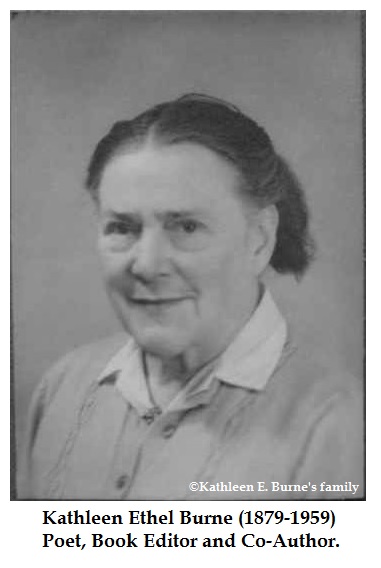
Photo supplied by Lesley Young.
Monday, 17 August 2015
Gertrud Kolmar (1894 - 1943)

Along with Nelly Sachs, Rose Ausländer and Else Lasker-Schüler, Gertrud Kolmar is considered to be one of the most significant German Jewish female poets.
Gertrud Chodziesner was born in Berlin in Chodziez (in German: Kolmar) in the Prussian Province of Posen. She grew up in Berlin and attended private schools. Her father was a criminal defence lawyer and her mother Elise, nee Schoenflies, was from a wealthy merchant family. Gertrud grew up in a family that loved literature - her father had some of his work published in the local newspaper. She worked in a kindergarten and studied Russian.
Gertrud became pregnant following her first and disappointing love affair when she was eighteen and her parents forced her to have an abortion, causing a suicide attempt. This upheaval and trauma in her life increased her sensitivity for human hardships, which is evident in her first volume of poetry - "Im Herbst" ("In Autumn"). This was followed by a volume called "Gedichte" ("Poems"), published in 1917 by Egon Fleischel & Co., Berlin. Gertrud adopted the pen name of Gertrud Kolmar.
During the First World War, Gertrud worked from 1916 - 1917 as an interpreter and censor in the POW camp Döberitz near Berlin.
After the war, Gertrud worked as a governess and taught handicapped children. She travelled to France, where she trained as an interpreter but had to return home due to her mother's deteriorating health. After the death of her mother in 1930, Gertrud became her father's secretary.
Gertrud's most important volume of work came after 1920, her last known work apparently being in 1937.
Gertrud was sent to a labour camp to work in a munitions factory in 1941 and her father was deported to a concentration camp where he died. Gertrud was sent to Auschwitz where she died on 2nd March 1943.
In 1993 a blue plaque was placed on Gertrud's family home and a street in Berlin was named after her.
The Female Poet
You hold me now entirely in your hands.
My heart beats like a frightened little bird
Against your palm. Take heed! You do not think
A person lives within the page you thumb.
To you this book is paper, cloth, and ink,
Just binding thread and glue, and is quite dumb,
And cannot touch you (though the gaze be great
That seeks you from the printed marks within),
And is an object with an object's fate.
And yet it has been veiled like a bride,
Adorned with gems, made ready to be loved,
Who asks you shyly to change your mind,
To wake yourself, and feel, and to be moved.
But still she trembles, whispering to the wind:
"This shall not be." And smiles as if she knew.
Yet she must hope. A woman always tries,
Her very life is but a single "You . . ."
With her black flowers and her painted eyes,
With silver chains and silks of spangled blue.
She knew more beauty when a child and free,
But now forgets the better words she knew.
A man is so much cleverer than we,
Conversing with himself of truth and lie,
Of death and spring and iron-work and time.
But I say "you" and always "you and I."
This book is but a girl's dress in rhyme,
Which can be rich and red, or poor and pale,
Which may be wrinkled, but with gentle hands,
And only may be torn by loving nails.
So then, to tell my story, here I stand.
The dress's tint, though bleached in bitter dye,
Has not all washed away. It still is real.
I call then with a thin, ethereal cry.
You hear me speak. But do you hear me feel?
Die Dichterin
Du hältst mich in den Händen ganz und gar.
Mein Herz wie eines kleinen Vogels schlägt
In deiner Faust. Der du dies liest, gib acht;
Denn sieh, du blätterst einen Menschen um.
Doch ist es dir aus Pappe nur gemacht,
Aus Druckpapier und Leim, so bleibt es stumm
Und trifft dich nicht mit seinem großen Blick,
Der aus den schwarzen Zeichen suchend schaut,
Und ist ein Ding und hat sein Dinggeschick.
Und ward verschleiert doch gleich einer Braut,
Und ward geschmückt, daß du es lieben magst,
Und bittet schüchtern, daß du deinen Sinn
Aus Gleichmut und Gewöhnung einmal jagst,
Und bebt und weiß und flüstert vor sich hin:
"Dies wird nicht sein." Und nickt dir lächelnd zu.
Wer sollte hoffen, wenn nicht eine Frau?
Ihr ganzes Treiben ist ein einzig: "Du..."
Mit schwarzen Blumen, mit gemalter Brau,
Mit Silberketten, Seiden, blaubesternt.
Sie wußte manches Schönere als Kind
Und hat das schöne andre Wort verlernt. -
Der Mann ist soviel klüger, als wir sind.
In seinen Reden unterhält er sich
Mit Tod und Frühling, Eisenwerk und Zeit;
Ich sage:"Du..." und immer:"Du und ich."
Und dieses Buch ist eines Mädchens Kleid,
Das reich und rot sein mag und ärmlich fahl,
Und immer unter liebem Finger nur
Zerknittern dulden will, Befleckung, Mal.
So steh ich, weisend, was mir widerfuhr;
Denn harte Lauge hat es wohl gebleicht,
Doch keine hat es gänzlich ausgespült.
So ruf ich dich. Mein Ruf ist dünn und leicht.
Du hörst, was spricht.
Vernimmst du auch, was fühlt?
My heart beats like a frightened little bird
Against your palm. Take heed! You do not think
A person lives within the page you thumb.
To you this book is paper, cloth, and ink,
Just binding thread and glue, and is quite dumb,
And cannot touch you (though the gaze be great
That seeks you from the printed marks within),
And is an object with an object's fate.
And yet it has been veiled like a bride,
Adorned with gems, made ready to be loved,
Who asks you shyly to change your mind,
To wake yourself, and feel, and to be moved.
But still she trembles, whispering to the wind:
"This shall not be." And smiles as if she knew.
Yet she must hope. A woman always tries,
Her very life is but a single "You . . ."
With her black flowers and her painted eyes,
With silver chains and silks of spangled blue.
She knew more beauty when a child and free,
But now forgets the better words she knew.
A man is so much cleverer than we,
Conversing with himself of truth and lie,
Of death and spring and iron-work and time.
But I say "you" and always "you and I."
This book is but a girl's dress in rhyme,
Which can be rich and red, or poor and pale,
Which may be wrinkled, but with gentle hands,
And only may be torn by loving nails.
So then, to tell my story, here I stand.
The dress's tint, though bleached in bitter dye,
Has not all washed away. It still is real.
I call then with a thin, ethereal cry.
You hear me speak. But do you hear me feel?
Die Dichterin
Du hältst mich in den Händen ganz und gar.
Mein Herz wie eines kleinen Vogels schlägt
In deiner Faust. Der du dies liest, gib acht;
Denn sieh, du blätterst einen Menschen um.
Doch ist es dir aus Pappe nur gemacht,
Aus Druckpapier und Leim, so bleibt es stumm
Und trifft dich nicht mit seinem großen Blick,
Der aus den schwarzen Zeichen suchend schaut,
Und ist ein Ding und hat sein Dinggeschick.
Und ward verschleiert doch gleich einer Braut,
Und ward geschmückt, daß du es lieben magst,
Und bittet schüchtern, daß du deinen Sinn
Aus Gleichmut und Gewöhnung einmal jagst,
Und bebt und weiß und flüstert vor sich hin:
"Dies wird nicht sein." Und nickt dir lächelnd zu.
Wer sollte hoffen, wenn nicht eine Frau?
Ihr ganzes Treiben ist ein einzig: "Du..."
Mit schwarzen Blumen, mit gemalter Brau,
Mit Silberketten, Seiden, blaubesternt.
Sie wußte manches Schönere als Kind
Und hat das schöne andre Wort verlernt. -
Der Mann ist soviel klüger, als wir sind.
In seinen Reden unterhält er sich
Mit Tod und Frühling, Eisenwerk und Zeit;
Ich sage:"Du..." und immer:"Du und ich."
Und dieses Buch ist eines Mädchens Kleid,
Das reich und rot sein mag und ärmlich fahl,
Und immer unter liebem Finger nur
Zerknittern dulden will, Befleckung, Mal.
So steh ich, weisend, was mir widerfuhr;
Denn harte Lauge hat es wohl gebleicht,
Doch keine hat es gänzlich ausgespült.
So ruf ich dich. Mein Ruf ist dünn und leicht.
Du hörst, was spricht.
Vernimmst du auch, was fühlt?
… (#1 biography) http://m.zeitzeichen.net/index.php?id=9321&MP=8-8939 (#2 biography) http://gedichte.xbib.de/biographie_Kolmar.htm (#3 opus) http://gedichte.xbib.de/gedicht_Kolmar.htm
m.zeitzeichen.net which allegedly shows her first poetry volume of 1917
The 1917 volume by Gertrud Kolmar is called "Gedichte" (poems), publisher: Egon Fleischel & Co., Berlin.
Here is one of the early poems, called "Verlorenes Lied" (lost song): http://www.ngiyaw-ebooks.org/ngiyaw/worte_zum_tag/2014/20140107.htm
www.ngiyaw-ebooks.org
(declared as official in 1951 by court ruling).
https://en.wikipedia.org/wiki/Gertrud_Kolmar
Penelope Monkhouse (*1952) is a German-British scientist living in Schwetzingen/Germany and is a granddaughter of the novelist, dramatist and literary critic Allan Monkhouse. Literature of the early 20th Century is one of her chief non-scientific interests and Penelope is currently engaged on a comparative study of German and English poetry of this period. She also writes poetry of her own and translates poetry to and from German and English.
Subscribe to:
Comments (Atom)